Glow in the Dark Epoxy: Complete Guide
How to create durable glow effects in epoxy floors and surfaces using Glow Powder, with practical guidance on preparation, protection, charging and anti-slip performance.

Introduction
Epoxy coatings are widely used to create hard-wearing, seamless and easy-to-clean surfaces. When combined with photoluminescent Glow Powder, epoxy can also provide a distinctive glow effect after the surrounding lights are switched off.
This creates an interesting option for decorative flooring, feature areas, pathways, commercial interiors and selected industrial applications.
Glow in the dark epoxy should not be thought of as a replacement for normal lighting. Its purpose is to create a visible glow effect and, where appropriately designed, provide additional visual guidance in low-light conditions.
The final result depends on the epoxy system, Glow Powder, application thickness, surface preparation, charging light and the design of the finished floor.
For industrial projects, it is particularly important to consider traffic, chemical exposure, abrasion, slip resistance and the compatibility of the complete coating system.
Benefits
Glow epoxy can provide:
- A seamless decorative finish.
- A durable protective coating when the appropriate epoxy system is used.
- Photoluminescent effects without electrical wiring.
- Attractive night-time visual effects.
- Customisable patterns and pathways.
- Easy-to-clean surfaces when correctly formulated.
- Integration with existing architectural and interior designs.
Typical Uses
Glow epoxy can be considered for:
- Decorative epoxy floors
- Commercial interiors
- Exhibition spaces
- Showrooms
- Entertainment venues
- Feature floors
- Walkways
- Architectural installations
- Selected industrial areas
- Garages and workshops
- Decorative concrete surfaces
- Stair and pathway features
For applications where the glow forms part of a regulated emergency or escape system, the complete installation must meet the applicable safety and performance requirements. Decorative Glow Powder should not automatically be considered a compliant safety marking system.
How Glow in the Dark Epoxy Works
- How It Works
- Key Facts
- Advantages
- Professional Tip
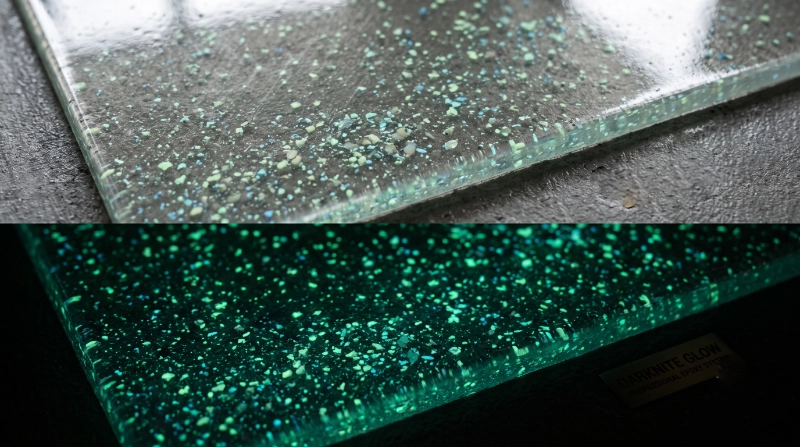
Glow in the dark epoxy is created by incorporating Glow Powder (Glow Pigment) into a compatible epoxy coating system.
The Glow Powder contains photoluminescent material that absorbs energy from light.
When the surrounding light is removed, the stored energy is gradually released as visible light.
The epoxy acts as the binder and protective coating that holds the Glow Powder in place.
This means the quality of the final result depends on both components:
Glow Powder provides the glow.
Epoxy provides the coating system.
The two must therefore be compatible with one another.
- Glow Powder is the photoluminescent component.
- Epoxy is the binder and protective coating.
- Clear or translucent epoxy generally allows more light to reach the Glow Powder.
- Dark or opaque coatings can reduce charging and visible glow.
- The Glow Powder must be sufficiently exposed within the coating system to perform effectively.
- The finished floor still requires appropriate curing before normal use.
Glow epoxy can combine decorative and functional characteristics.
Depending on the formulation and application, it can provide:
- A seamless appearance.
- Durable surface protection.
- Customisable glow patterns.
- Easy maintenance.
- Good resistance to normal wear when correctly specified.
- Integration with existing epoxy flooring systems.
For demanding industrial environments, the epoxy formulation should be selected based on the actual operating conditions rather than choosing a product based solely on its glow performance.
Professional Tip
During application, periodically switch off the lights and inspect your work using a UV black light. This reveals missed areas, uneven coverage and ensures the best glow performance. The same technique is recommended for UV reactive paints as the black light immediately reveals the finished effect.
For epoxy floors, this is particularly useful for checking whether Glow Powder has been distributed consistently across the intended areas before the coating cures.
Types of Glow Epoxy Finishes
Full Glow Epoxy Floor
A complete epoxy floor can incorporate Glow Powder throughout the selected coating layer for an overall glow effect.
This approach is suitable where the glow itself is a major part of the design.

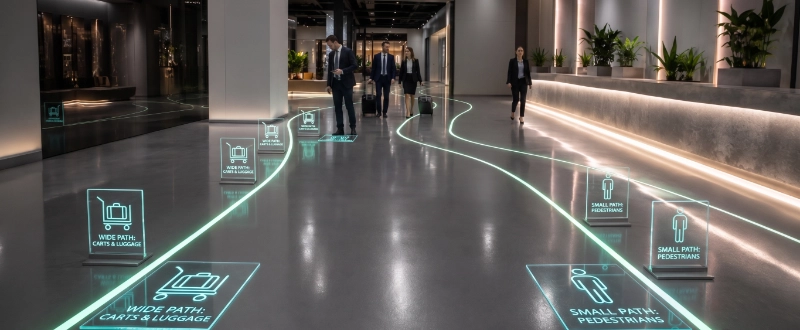
Glow Pathways
Glow Powder can be incorporated into selected sections of an epoxy floor to create pathways or directional lines.
This generally uses less material than coating the entire floor and can produce a cleaner architectural appearance.
Decorative Glow Patterns
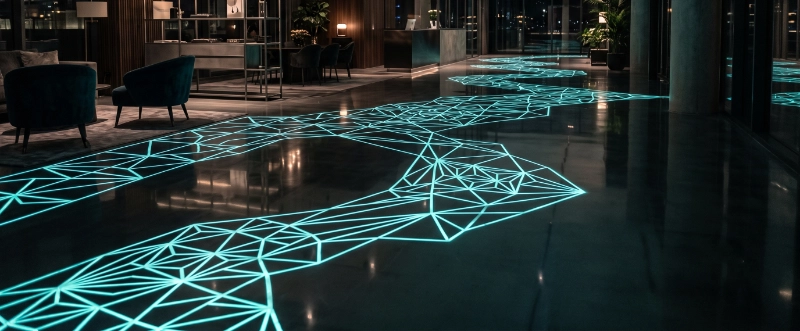
Geometric shapes, borders and abstract designs can be incorporated into epoxy flooring.
This allows the floor to remain understated during normal lighting while revealing a different design after dark.
Glow Aggregate Effects
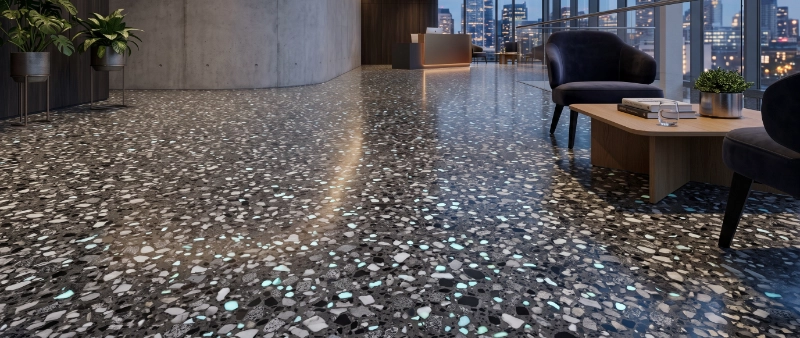
Decorative aggregate can be combined with suitable epoxy systems to create textured or terrazzo-style floors with selected glowing elements.
Glow materials should be positioned and exposed appropriately so they can receive charging light.
Glow Safety-Style Edges
Glow effects can be incorporated into selected floor edges, steps or pathways to make architectural transitions more visible in low-light environments.
Where the application is intended as a formal safety system, however, the complete installation must meet the relevant safety requirements.
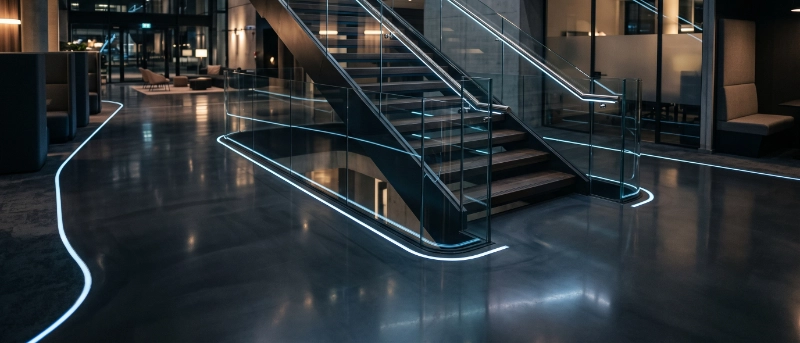
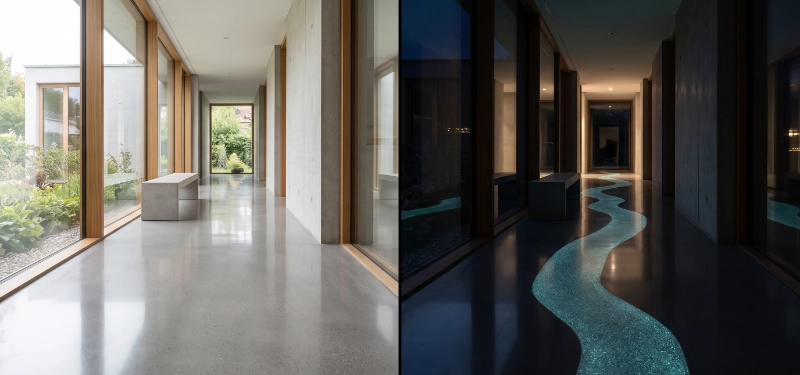
Day vs Night Appearance
- Day Appearance
- Night Appearance
- Lighting
- Best Results
During normal lighting, a glow epoxy floor can look similar to a conventional decorative epoxy floor.
The Glow Powder may be visible depending on its concentration, colour and distribution, or it can be incorporated selectively into patterns and designated areas.
This makes it possible to design a floor that works visually during the day while providing a completely different effect after dark.
Once the main lights are switched off, the photoluminescent material begins releasing its stored energy.
The strongest glow is normally seen shortly after charging, gradually reducing as the stored energy is released.
A completely dark environment makes the effect much more noticeable than a room containing strong ambient lighting.
Glow epoxy can be charged using:
- Natural sunlight
- Bright LED lighting
- Fluorescent lighting
- UV black lights
A UV black light is particularly useful during installation because it allows the applicator to inspect the distribution of Glow Powder and rapidly demonstrate the finished effect.
For large industrial floors, however, the normal operating environment and available charging light should be considered during the design stage.
For the best combination of appearance and glow performance:
- Use a compatible epoxy system.
- Use clear or translucent epoxy where appropriate.
- Apply Glow Powder consistently.
- Prepare the substrate correctly.
- Allow each coating layer to cure according to the manufacturer's requirements.
- Provide adequate charging light.
- Test the complete coating system before large-scale application.
- Consider the required slip resistance and durability of the finished floor.
Important: A highly polished epoxy floor can become slippery when contaminated with water, oil or other substances. For areas where slip resistance is important, the complete floor system should be designed with an appropriate anti-slip finish or texture.
Brightness Expectations
- Brightness
- Charging
- Glow Duration
- Performance Factors
The brightness of glow in the dark epoxy depends on several factors, not simply the amount of Glow Powder added.
Important factors include:
- Quality and colour of the Glow Powder.
- Pigment concentration.
- Thickness of the coating.
- Transparency of the epoxy.
- Amount of charging light.
- Charging time.
- Surface colour beneath the epoxy.
- Ambient darkness.
A clear or lightly tinted epoxy generally allows more charging light to reach the Glow Powder than a heavily pigmented or opaque system.
For commercial or industrial projects, a sample panel should be produced before full application so the actual appearance can be assessed.
Glow Powder stores energy from exposure to light.
Suitable charging sources include:
- Direct sunlight
- Bright LED lighting
- Fluorescent lighting
- UV black lights
UV black lights are particularly effective for rapidly charging Glow Powder during testing and for inspecting an application.
For permanent installations, however, the normal lighting conditions of the space should be considered. A floor located in a permanently dark area may not receive enough light to achieve the expected charging performance.
Glow is normally strongest immediately after the charging light is removed and gradually decreases over time.
The visible duration depends on:
- Glow Powder formulation.
- Initial charging intensity.
- Length of charging time.
- Coating thickness.
- Ambient darkness.
- Surrounding lighting.
It is therefore better to describe glow performance in terms of initial brightness and gradual fade rather than promising a fixed number of hours under every condition.
| Factor | Effect |
|---|
| High-quality Glow Powder | Stronger and more consistent glow |
| Clear epoxy | Better light penetration |
| Adequate pigment loading | Greater visible glow |
| Bright charging light | Faster charging |
| Longer charging period | More stored energy |
| White/light substrate | Can improve visible brightness |
| Dark substrate | May reduce perceived brightness |
| Strong ambient lighting | Makes the glow appear weaker |
| Dirt or contamination | Can reduce the visible effect |
Choosing Products
| Product | Best For | Location | Difficulty | Notes |
|---|---|---|---|---|
| Glow Powder | Creating the photoluminescent effect within epoxy | Indoor/Outdoor | Moderate | Must be compatible with the selected epoxy system. |
| Glow Epoxy | Complete glow floor or coating system | Indoor/Outdoor | Medium Hard | Best for projects requiring an integrated epoxy coating. |
| Primer | Preparing suitable substrates before the glow coating | Indoor/Outdoor | Moderate | Particularly useful where a suitable base is required. |
| UV Lights | Charging and inspection | Indoor/Outdoor | NA | Useful for testing coverage and demonstrating glow performance. |
*The complete coating system must be suitable for the specific environment and exposure conditions.
Materials Required
Creating glow epoxy requires both a suitable resin system and a compatible photoluminescent pigment. See our Epoxy Resin and Glow Powder pages for the materials used in glow resin projects.
Recommended Products
For a typical glow epoxy flooring project:
- Glow Epoxy
- Glow Powder
- Glow Primer, where required by the coating system
- UV Lights for testing and application inspection
The most important consideration is compatibility. The Glow Powder, epoxy, primer and any protective topcoat should form a suitable coating system rather than being selected independently.
The resin itself is just as important as the glow pigment. If you are starting a glow resin project, see our Epoxy Resin range for suitable resin materials to combine with glow pigments.
Important Note About Topcoats
A protective clear topcoat may be appropriate where the floor requires additional abrasion, chemical or surface protection.
However, the topcoat must be selected carefully. A thick, opaque or strongly tinted topcoat can reduce the amount of light reaching the Glow Powder and may reduce the visible glow.
Surface Preparation & Application
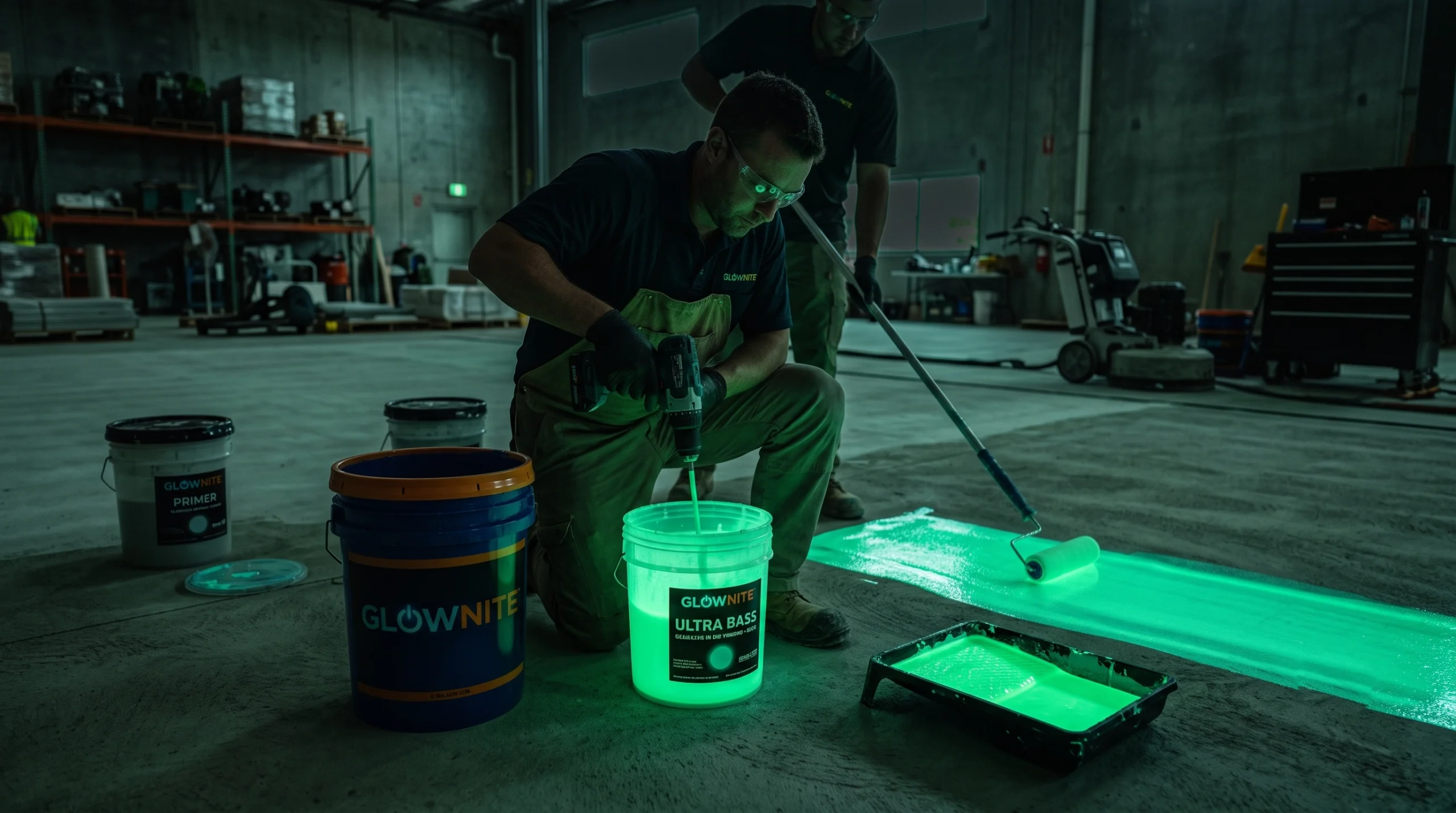
Surface Preparation
The performance of an epoxy floor begins with proper substrate preparation.
For concrete floors:
- Remove dirt, grease and contaminants.
- Remove loose or poorly bonded material.
- Repair cracks and damaged areas where necessary.
- Mechanically prepare the surface where required.
- Ensure the substrate is suitably dry.
- Check for moisture problems before coating.
- Apply Glow Primer where specified by the coating system.
Existing coatings should also be checked for adhesion and compatibility before applying a new epoxy system.
A poorly prepared substrate can cause adhesion failure regardless of how well the Glow Powder itself performs.
Materials Needed
A typical project may require:
- Glow Epoxy
- Glow Powder, if preparing a custom formulation
- Glow Primer
- Suitable mixing containers
- Accurate measuring equipment
- Mixing tools
- Rollers or squeegees
- Brushes for edges
- Masking materials
- UV black light
- Appropriate protective equipment
- Anti-slip aggregate or texture system where required
- Compatible protective topcoat where specified
Application Steps
- Inspect and assess the substrate.
- Clean and mechanically prepare the surface as required.
- Repair defects and allow repairs to cure.
- Check substrate moisture and environmental conditions.
- Apply Glow Primer if required.
- Prepare the epoxy system according to the manufacturer's mixing instructions.
- Add Glow Powder at the specified loading where a custom formulation is being used.
- Mix thoroughly and consistently.
- Apply the epoxy at the recommended coverage and thickness.
- Inspect the application using a UV black light.
- Correct missed or uneven areas while the coating remains workable.
- Allow the coating to cure fully.
- Apply a compatible protective or anti-slip topcoat where required.
- Allow the complete system to cure before normal traffic.
Professional Tips
Professional Tip
During application, periodically switch off the lights and inspect your work using a UV black light. This reveals missed areas, uneven coverage and ensures the best glow performance. The same technique is recommended for UV reactive paints as the black light immediately reveals the finished effect.
For large floors, divide the project into manageable sections and maintain consistent mixing and application rates.
Always keep a record of:
- Mixing ratios
- Glow Powder loading
- Batch numbers
- Coverage rates
- Application conditions
- Curing times
This is particularly useful for commercial and industrial projects where consistency between batches is important.
Safety Notes
- Follow the epoxy manufacturer's safety instructions.
- Wear appropriate gloves and protective equipment.
- Ensure adequate ventilation.
- Avoid skin and eye contact with uncured materials.
- Keep ignition sources away from products where required by the manufacturer's safety data.
- Never allow normal traffic before the coating has fully cured.
- Never shine UV lights directly into the eyes.
- Ensure the finished floor has appropriate slip resistance for its environment.
Common Mistakes
Treating Glow Powder as a Substitute for Epoxy
Why it happens:
Glow Powder provides the glow but does not provide the binder, adhesion or protective properties required of a floor coating.
How to avoid it:
Use Glow Powder as part of a suitable coating formulation with an appropriate epoxy system.
Applying Epoxy to an Unprepared Floor
Why it happens:
The existing concrete may look clean enough to coat.
How to avoid it:
Properly remove contaminants and prepare the substrate before application.
Adding Too Much Glow Powder
Why it happens:
It is tempting to assume more powder automatically means a better floor.
How to avoid it:
Use a tested formulation and follow the recommended loading for the epoxy system.
Using an Opaque Epoxy System
Why it happens:
A dark decorative floor may look attractive under normal lighting.
How to avoid it:
Use a clear or suitably translucent system where strong glow performance is required.
Applying an Unsuitable Topcoat
Why it happens:
A protective topcoat is selected solely for durability.
How to avoid it:
Check that the topcoat is compatible with the epoxy and does not unnecessarily block charging light.
Ignoring Slip Resistance for Human Traffic
Why it happens:
The visual appearance of a polished epoxy floor receives more attention than its wet performance.
How to avoid it:
Specify an appropriate anti-slip system for areas exposed to water, oils or heavy pedestrian traffic.
Not Testing the Complete System
Why it happens:
Individual components may appear suitable when tested separately.
How to avoid it:
Create a sample using the actual substrate, primer, Glow Powder, epoxy and protective topcoat before proceeding with a large project.
Expecting Glow to Replace Lighting
Why it happens:
Strong glow effects can appear bright in photographs taken in controlled darkness.
How to avoid it:
Treat glow as a decorative or supplementary visual feature unless the complete system has been specifically designed, tested and approved for a regulated safety application.
Key Takeaways
- Glow in the dark epoxy combines a suitable epoxy coating system with photoluminescent Glow Powder.
- Glow Powder and Glow Pigment are the same product.
- Clear or translucent epoxy generally provides better charging and glow visibility.
- Proper substrate preparation is essential for epoxy adhesion and durability.
- A compatible protective topcoat can improve surface protection but must not unnecessarily block charging light.
- Anti-slip performance should be considered for floors exposed to water, oils or heavy traffic.
- Always test the complete coating system before large commercial or industrial application.
- Glow should not automatically be treated as a replacement for conventional or regulated emergency lighting.
Related Resin Projects
Glow epoxy can be used for floors, tables, decorative surfaces and artistic projects. For a broader introduction to working with glow materials in resin, see our Glow in the Dark Resin Guide.
Looking for more glow-in-the-dark ideas,
techniques and applications?
Explore our complete guide.