Glow in the Dark Cosmic Bowling Centres
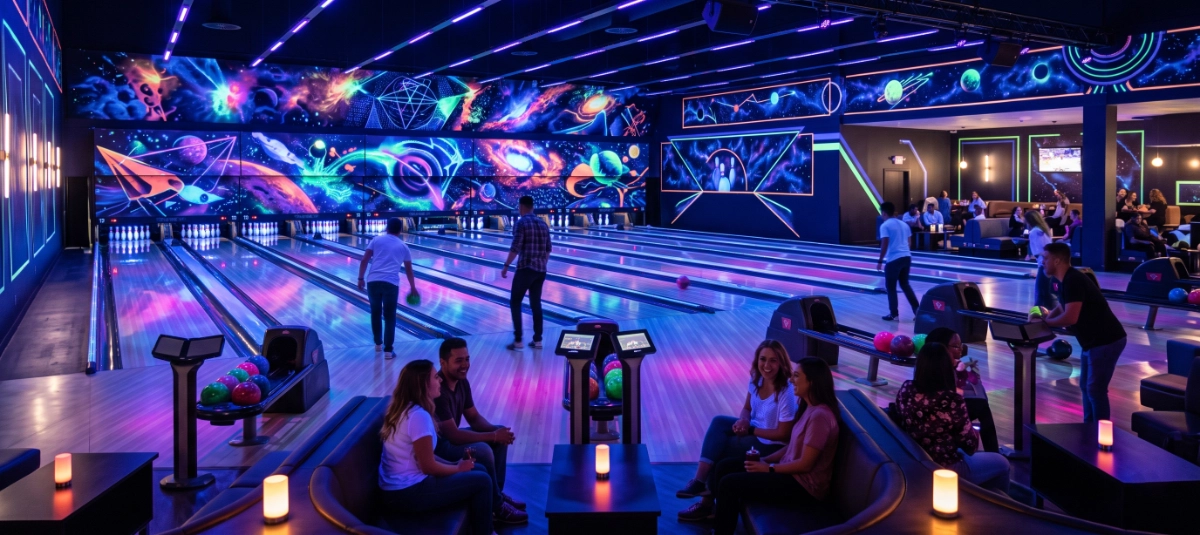
Create an immersive bowling experience with Glow Paint, UV Reactive Paint and blacklight UV lighting — from glowing walls and murals to dramatic cosmic bowling lanes.
Creating a Cosmic Bowling Experience
A conventional bowling centre can be transformed into a completely different environment when normal lighting is replaced or supplemented with UV blacklight and glow effects.
Cosmic bowling, UV bowling and blacklight bowling typically use ultraviolet lighting to make specially formulated fluorescent colours appear dramatically brighter. UV Reactive Paint is particularly effective for walls, murals, graphics and decorative features because it fluoresces when exposed to UV light.
Glow Paint works differently. It absorbs light and continues to glow after the charging light is removed. This makes it useful for selected pathways, architectural details and other features where a persistent glow effect is desired.
Combining both technologies allows a bowling centre to have an immersive visual experience while the main UV lighting is operating, with additional photoluminescent effects that remain visible after lighting levels are reduced.
Benefits
A well-designed cosmic bowling centre can provide:
- A distinctive entertainment environment.
- Strong visual impact under UV lighting.
- Themed walls and murals.
- Interactive-looking lane and architectural features.
- A memorable experience for groups and events.
- Opportunities for themed parties and special sessions.
- Flexible designs that can be refreshed or changed over time.
- A combination of UV-reactive and glow-in-the-dark effects.
Typical Uses
UV and glow products can be incorporated into:
- Bowling lane surroundings
- Feature walls
- Bowling centre murals
- Pillars and columns
- Ceiling features
- Reception areas
- Seating zones
- Bar and refreshment areas
- Party rooms
- Directional graphics
- Themed architectural details
- Decorative floor and wall features
The strongest designs usually combine several effects rather than covering every surface with glowing material.
How It Works
- How It Works
- Key Facts
- Advantages
- Professional Tip
There are two main visual technologies that can be combined in a cosmic bowling centre.
UV Reactive Paint
UV Reactive Paint contains fluorescent materials that respond to ultraviolet light.
When exposed to suitable UV lighting, colours that may appear ordinary under normal lighting can become dramatically brighter and more vibrant.
This makes UV Reactive Paint ideal for:
- Murals
- Artwork
- Graphics
- Signs
- Decorative patterns
- Feature walls
- Ceiling designs
The fluorescent effect is strongest while the UV lighting is operating.
UV Effects
For installations combining phosphorescent glow with fluorescent effects, UV-reactive materials can add another visual dimension. See our UV Black Lights and UV Fluorescent and UV Reactive Powder pages.
Glow Paint
Glow Paint contains photoluminescent material that stores energy from light and gradually releases it after the light source is removed.
This makes it useful for:
- Glowing pathway accents
- Architectural features
- Selected floor details
- Decorative borders
- Low-light visual effects
The two technologies can be used together to create a more layered visual experience.
- UV Reactive Paint requires
- UV light to produce its fluorescent effect.
- Glow Paint charges from exposure to light and continues glowing after the charging source is removed.
- UV blacklights are commonly used for cosmic bowling environments.
- UV Reactive Paint is particularly effective for bright murals and artwork.
- Glow Paint is better suited to persistent after-dark glow effects.
- Dark surroundings make both effects more visually impressive.
- The design should account for normal lighting as well as the UV experience.
Combining UV and glow technology gives designers greater flexibility.
A bowling centre can look relatively conventional during normal operating hours and transform dramatically during a cosmic bowling session.
Different areas can also have different visual treatments.
For example:
Bowling lanes: subtle glow accents.
Walls: bright UV Reactive Paint murals.
Ceilings: fluorescent stars, planets or abstract patterns.
Reception: branded UV artwork.
Party rooms: stronger themed designs.
This creates visual variety without requiring every surface to glow.
Professional Tip
During application, periodically switch off the lights and inspect your work using a UV black light. This reveals missed areas, uneven coverage and ensures the best glow performance. The same technique is recommended for UV reactive paints as the black light immediately reveals the finished effect.
For a bowling centre, this is especially useful when inspecting large murals, graphics and decorative coatings before the final installation is completed.
Types of Cosmic Bowling Finishes
UV Reactive Wall Murals
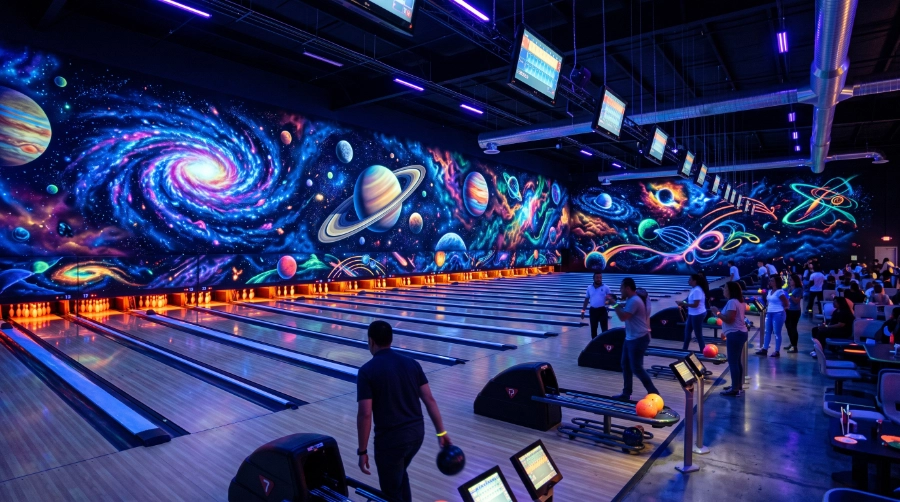
Large UV Reactive Paint murals can become the main visual attraction of a bowling centre.
Themes could include space, galaxies, planets, futuristic graphics, abstract patterns or bowling-related artwork.
Glow Lane Accents
Glow Paint can be used selectively around bowling lanes to create subtle glowing borders and architectural accents.
The effect should complement the lane lighting rather than interfere with normal bowling visibility.
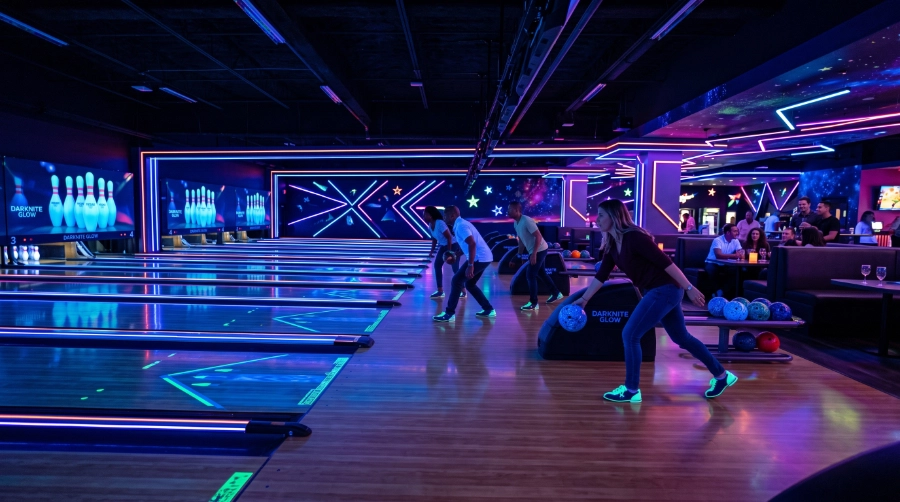
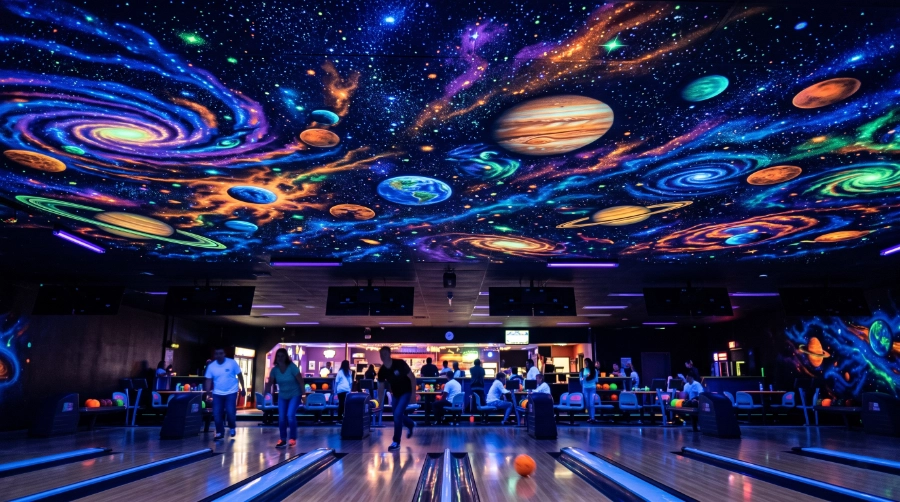
UV Reactive Ceiling Design
The ceiling can become part of the cosmic experience with UV Reactive Paint stars, planets, abstract shapes and fluorescent patterns.
This is particularly effective because it extends the visual experience above the lanes.
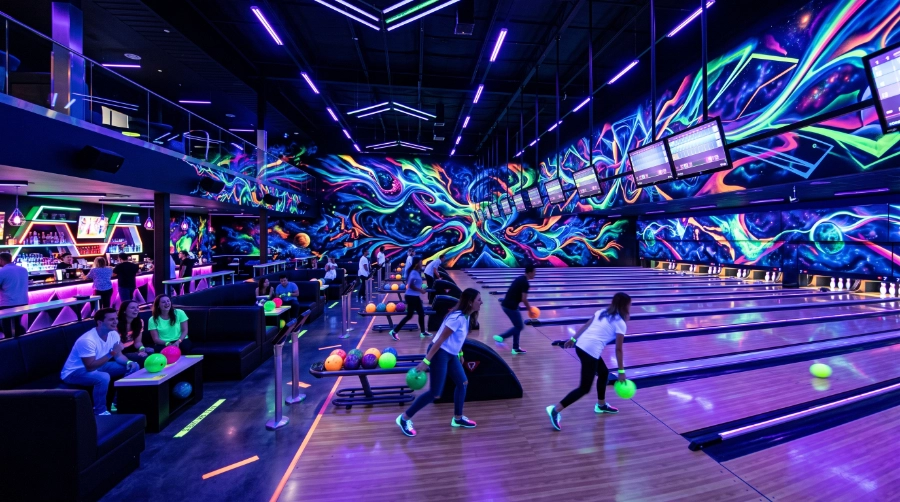
Interactive Bowling Graphics
UV Reactive Paint can be used to create arrows, abstract pathways, geometric shapes and visual movement around the bowling area.
These designs can make the space feel more dynamic without physically changing the bowling lanes.
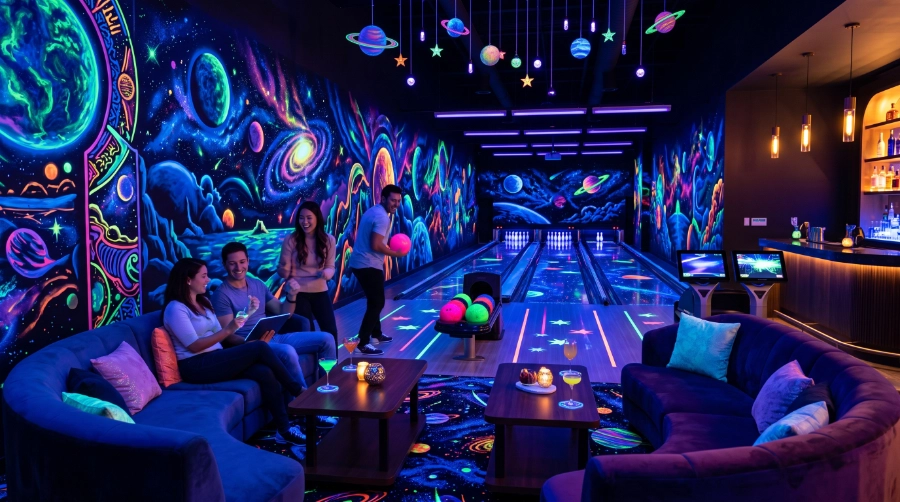
Themed Party Zones
Smaller rooms or seating areas can use concentrated UV artwork and glow effects to create themed spaces for parties and events.
Possible themes include:
- Space
- Underwater
- Jungle
- Futuristic
- Neon geometric
- Fantasy
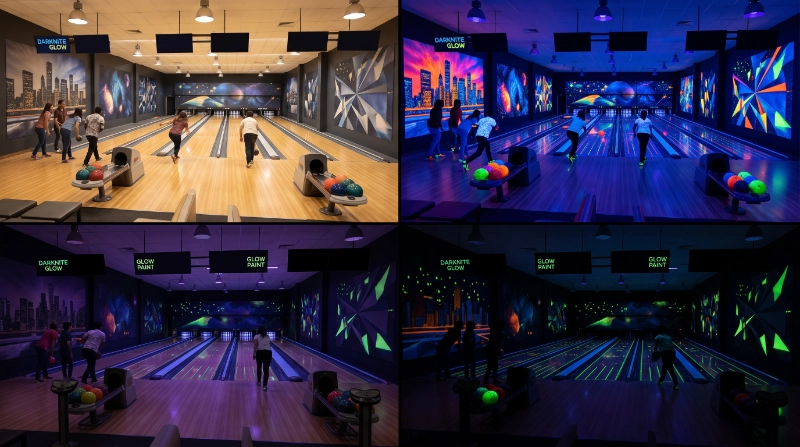
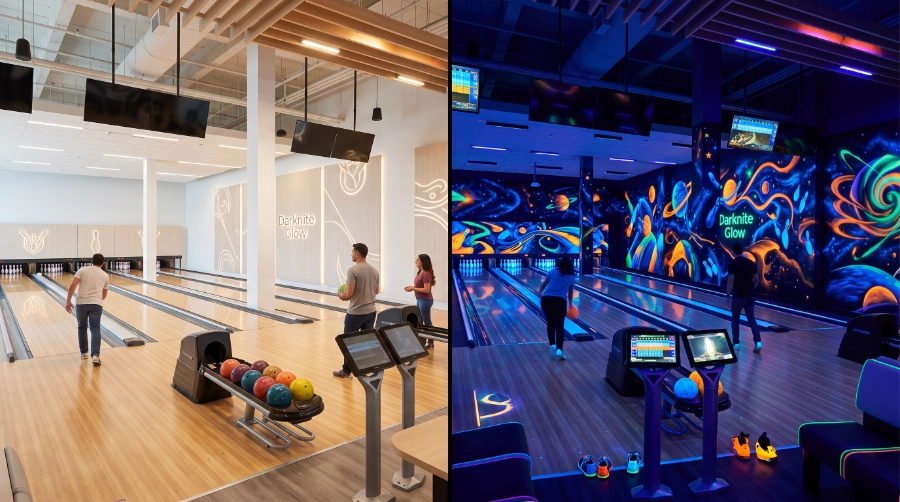
Day vs Night Appearance
- Day Appearance
- Night Appearance
- Lighting
- Best Results
During normal lighting, UV Reactive Paint may appear as conventional painted artwork, although some fluorescent colours can still appear brighter than standard pigments.
Glow Paint may also appear relatively subtle during normal lighting, depending on its formulation and the colour of the underlying surface.
This gives designers an opportunity to create a venue that remains attractive even when cosmic bowling is not operating.
When the main lighting is reduced and UV blacklights are switched on, the environment can change dramatically.
UV Reactive Paint becomes highly fluorescent, making murals, graphics and decorative artwork appear much brighter.
Glow Paint can provide an additional layer of illumination where the surrounding light levels are sufficiently low.
The combination can produce depth and visual contrast throughout the bowling centre.
The UV lighting system is one of the most important parts of a successful cosmic bowling installation.
The lighting should be planned to:
- Illuminate UV Reactive Paint evenly.
- Minimise dark patches.
- Avoid excessive glare.
- Complement the bowling lanes.
- Cover murals and architectural features.
- Avoid creating uncomfortable viewing conditions.
UV lighting should be positioned according to the size and layout of the venue rather than simply adding more lights.
For the most effective cosmic bowling environment:
- Use UV Reactive Paint for large murals and fluorescent artwork.
- Use Glow Paint selectively for persistent glow effects.
- Plan UV light coverage before painting.
- Test colours under the actual UV lights being installed.
- Avoid excessive visual clutter.
- Use darker surrounding surfaces to increase contrast.
- Keep bowling areas practical and safe.
- Consider how the venue looks under both normal and cosmic lighting.
A small-scale test area is highly recommended before committing to a large mural or complete venue design.
Brightness Expectations
- Brightness
- Charging
- Glow Duration
- Performance Factors
The visual brightness of a cosmic bowling centre depends on the type of effect being used.
UV Reactive Paint can appear extremely vibrant under suitable UV blacklights because the fluorescent pigments react directly to ultraviolet light.
Glow Paint behaves differently. It stores energy from light and releases it gradually when the light source is reduced or removed.
For this reason, UV Reactive Paint is generally the better choice for dramatic murals and artwork during an active cosmic bowling session, while Glow Paint is useful for selected features that need to remain visible after the main lighting is reduced.
Glow Paint needs to be exposed to light before it can glow effectively.
Suitable charging sources include:
- Daylight
- Bright LED lighting
- Suitable artificial lighting
- UV blacklights
UV Reactive Paint does not work in the same way. Its fluorescent effect is produced while it is being exposed to UV light.
A good cosmic bowling design therefore considers both UV illumination and photoluminescent charging where both effects are being used.
Glow Paint is brightest shortly after sufficient charging and gradually fades as the stored energy is released.
The actual duration depends on:
- Glow Paint formulation
- Charging intensity
- Charging time
- Surface coverage
- Ambient darkness
- Surrounding light levels
UV Reactive Paint remains visibly fluorescent while suitable UV light is present. When the UV lighting is switched off, the fluorescent effect normally stops rather than continuing to glow like Glow Paint.
| Factor | Effect |
|---|---|
| Strong UV lighting | Increases UV Reactive Paint fluorescence |
| Good UV coverage | Produces more even fluorescent effects |
| High-quality Glow Paint | Provides stronger photoluminescent effects |
| Adequate charging | Improves Glow Paint performance |
| Dark surroundings | Makes glow effects more visible |
| Clean painted surfaces | Maintains better appearance |
| Correct paint application | Produces more consistent results |
| Poor UV positioning | Can create uneven fluorescence |
For large bowling centres, UV lighting should ideally be tested with the actual painted surfaces before the final installation.
Choosing Products
| Product | Best For | Location | Difficulty | Notes |
|---|---|---|---|---|
| UV Reactive Paint | Murals, artwork, graphics and feature walls | Indoor/Outdoor | Hard | Best for dramatic fluorescence under UV blacklights. |
| Glow Paint | Glow accents, pathways and architectural details | Indoor/Outdoor | Hard | Stores light and continues glowing after charging |
| Glow Primer | Base preparation for Glow Paint | Indoor/Outdoor | Medium Hard | Useful where a suitable reflective base is required. |
| Glow Tape | Edge marking with no traffic | Indoor/Outdoor | Easy | Just cut and stick on any surface |
| Glow Aluminum Plates | Edge marking with heavy traffic | Indoor/Outdoor | Medium | Needs drilling or heavy duty glue for proper installation |
| UV Lights | Activating UV Reactive Paint | Indoor/Outdoor | Moderate | Essential for creating the blacklight/cosmic effect. |
*The specific product and coating system must be suitable for the environment.
Glow Materials for Bowling Centres
Glow powder and glow paint can both be used to create dramatic visual effects in entertainment spaces. See our Glow Powder and Glow Paint ranges when planning a glow bowling installation.
Recommended Products
For a typical cosmic bowling installation:
- UV Reactive Paint — for murals and fluorescent artwork.
- Glow Paint — for selected glow-in-the-dark accents.
- Glow Primer — where required beneath Glow Paint.
- UV Lights — to illuminate the UV Reactive Paint.
Choosing Between Glow Paint and UV Reactive Paint
The distinction is important.
Choose UV Reactive Paint when you want:
- Bright fluorescent murals.
- Artwork that reacts dramatically under blacklight.
- Strong colour effects during cosmic bowling.
- Large themed graphics.
Choose Glow Paint when you want:
- A glow that continues after charging.
- Subtle architectural accents.
- Glowing borders or pathways.
- Additional effects when the surrounding light is reduced.
Using both technologies together can create a much richer environment.
Surface Preparation & Application
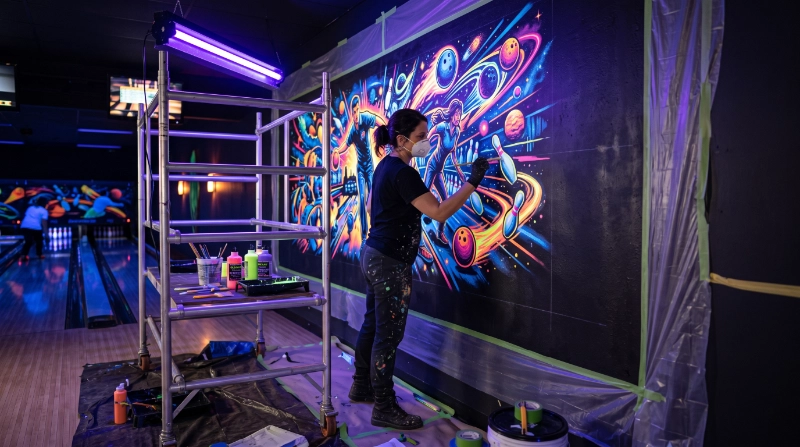
Surface Preparation
Good preparation is essential for both Glow Paint and UV Reactive Paint.
Before painting:
- Remove dust and dirt.
- Remove grease and other contaminants.
- Repair damaged areas.
- Ensure the surface is dry.
- Remove loose or poorly bonded paint.
- Sand or mechanically prepare glossy surfaces where necessary.
- Apply a suitable primer where required.
For large commercial venues, inspect existing wall coatings before beginning. A test area should be used to confirm adhesion and appearance.
Materials Needed
Depending on the design, the project may require:
- UV Reactive Paint
- Glow Paint
- Glow Primer
- UV Lights
- Suitable standard primer
- Paint rollers
- Brushes
- Spray equipment where appropriate
- Masking tape
- Stencils
- Drop sheets
- UV blacklight for inspection
- Protective gloves and other appropriate PPE
Application Steps
- Inspect the existing surface.
- Clean and prepare the substrate.
- Repair cracks, holes or damaged coatings.
- Apply a suitable base or primer where necessary.
- Plan the mural, graphics or glow design.
- Apply UV Reactive Paint or Glow Paint according to the product requirements.
- Allow each coat to dry before applying the next.
- Use a UV blacklight to inspect coverage.
- Correct missed areas and uneven sections.
- Allow the completed coating to dry and cure fully.
- Test the finished installation under the actual UV lighting.
- Make final adjustments to lighting or artwork where required.
Professional Tips
Professional Tip
During application, periodically switch off the lights and inspect your work using a UV black light. This reveals missed areas, uneven coverage and ensures the best glow performance. The same technique is recommended for UV reactive paints as the black light immediately reveals the finished effect.
For a commercial bowling centre, test the paint under the actual UV lights that will be installed. A colour that looks impressive under one blacklight may appear different depending on UV output, distance and positioning.
Safety Notes
- Work in a well-ventilated area.
- Follow the paint manufacturer's application instructions.
- Wear suitable protective equipment.
- Keep paint away from children during application.
- Allow coatings to dry and cure before normal use.
- Never shine UV lights directly into the eyes.
- Ensure electrical and UV lighting installations are professionally installed where appropriate.
Common Mistakes
Using Ordinary Paint for UV Artwork
Why it happens:
Standard paint may appear colourful under normal lighting but does not necessarily fluoresce under UV light.
How to avoid it:
Use properly formulated UV Reactive Paint for areas intended to fluoresce.
Using Glow Paint for Everything
Why it happens:
Glow Paint and UV Reactive Paint are sometimes treated as interchangeable.
How to avoid it:
Use UV Reactive Paint for dramatic blacklight artwork and Glow Paint where a persistent glow effect is required.
Insufficient UV Lighting
Why it happens:
The paint is selected first and lighting is considered later.
How to avoid it:
Plan the UV lighting and artwork together and test the actual paint under the proposed lighting.
Poor Surface Preparation
Why it happens:
Large walls can appear clean enough to paint without proper preparation.
How to avoid it:
Clean, repair and prepare the surface before application.
Uneven UV Coverage
Why it happens:
UV lights are positioned too far apart or at unsuitable angles.
How to avoid it:
Test the entire space and identify dark spots before finalising the lighting layout.
Too Much Visual Clutter
Why it happens:
Designers may try to make every wall and surface glow.
How to avoid it:
Create focal points and leave darker areas between major designs. Contrast often produces a stronger overall effect.
Ignoring Normal Lighting
Why it happens:
The design is evaluated only under blacklight.
How to avoid it:
Review the artwork under both normal lighting and cosmic bowling conditions.
Forgetting Maintenance
Why it happens:
UV artwork can be treated as a one-time installation.
How to avoid it:
Use durable, appropriate coatings and establish a maintenance schedule for cleaning, touch-ups and UV lighting inspection.
Key Takeaways
- Cosmic bowling combines UV blacklight with fluorescent artwork and atmospheric lighting.
- UV Reactive Paint is ideal for murals, graphics and large fluorescent designs.
- Glow Paint stores light and continues glowing after the charging light is reduced or removed.
- Using UV Reactive Paint and Glow Paint together can create layered visual effects.
- UV lighting should be planned together with the artwork rather than added afterwards.
- Test the actual paint under the intended UV lights before large-scale application.
- Avoid covering every surface with bright artwork; contrast makes focal areas more effective.
- Commercial bowling centres should consider maintenance, safety, lighting coverage and normal daytime appearance as well as the cosmic experience.
Looking for more glow-in-the-dark ideas,
techniques and applications?
Explore our complete guide.