Glow in the Dark Emergency Exit Systems
How photoluminescent safety signs, Glow Stickers, Glow Tape and Glow Paint can improve visibility along emergency escape routes.
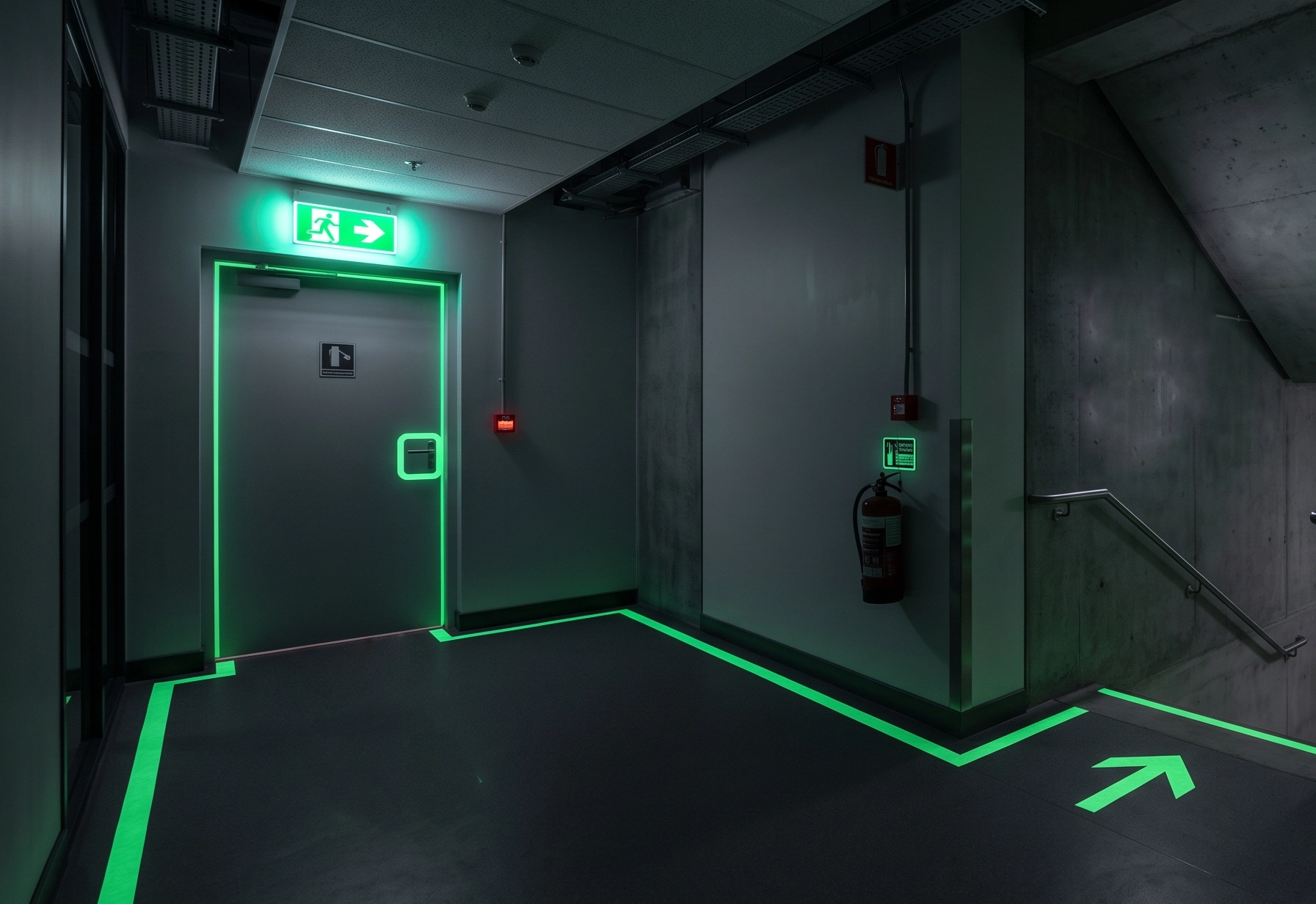
Why Glow in the Dark Safety Signs Matter
During a power failure, fire or other emergency, occupants need to identify exits and follow escape routes quickly and confidently.
Emergency lighting and illuminated exit signs form an important part of this system. Photoluminescent materials can provide an additional layer of visibility by absorbing light during normal conditions and releasing it as a visible glow when the surrounding light is reduced.
This is the principle behind glow in the dark safety signs, photoluminescent exit markings and low-level escape-route products.
Photoluminescent systems are particularly useful because they do not depend on a continuous electrical power supply to produce their basic glow. However, their performance depends on receiving sufficient charging light before the emergency occurs.
They should therefore be regarded as part of a properly designed fire and life-safety system rather than as a universal substitute for emergency lighting.
In Singapore, for example, the Fire Code addresses both emergency lighting and photoluminescent marking. It states that photoluminescent marking/tape is intended to help guide occupants during total power failure or low ambient lighting conditions.
Benefits
A properly designed photoluminescent system can provide:
- Additional visibility during low-light conditions.
- Low-level guidance along escape routes.
- Clearly identifiable directional markings.
- Visibility around staircases and changes in level.
- Additional guidance if normal lighting fails.
- Passive operation without continuous electrical power.
- Easy-to-see markings close to floor level.
- A useful supplementary layer to emergency lighting.
Typical Uses
Glow in the dark safety signage and markings can be used for:
- Emergency exit routes
- Fire exit doors
- Exit staircases
- Corridor directional markings
- Stair nosings
- Handrails
- Smoke-free lobbies
- Fire lift lobbies
- Emergency exit doors
- Low-level directional arrows
- Wall-mounted exit indicators
- Floor-level escape-route markings
Singapore's Fire Code, for example, specifies photoluminescent marking/tape in several escape-route locations, including exit staircases, smoke-free lobbies, fire lift lobbies and corridors with exit directional signs.
A complete photoluminescent escape route may incorporate signs, pathway markings and stair-edge identification. Relevant solutions include Glow Safety Tape and Glow Stair Nosing.
How Glow in the Dark Emergency Exit Systems Work
- How It Works
- Key Facts
- Advantages
- Professional Tip
Photoluminescent materials contain substances that absorb energy from surrounding light.
During normal building operation, daylight or artificial lighting charges the material.
When the light source is reduced or removed, the stored energy is gradually released as visible light.
This creates a passive glow that can help occupants identify important features such as:
- Exit directions
- Stair edges
- Corridor routes
- Doors
- Handrails
- Floor-level markings
Unlike an electrically powered sign, a photoluminescent sign does not require a battery or continuous electrical connection to produce its basic glow.
However, it must receive adequate charging light to perform effectively.
- Photoluminescent materials absorb and store light energy.
- They emit visible light after the charging source is removed.
- The glow gradually decreases over time.
- Charging conditions affect performance.
- Dirt, damage and surface contamination can reduce visibility.
- Photoluminescent markings are particularly useful at low level.
- Product performance should be assessed against the requirements of the intended application.
- Regulatory requirements vary by location and building type.
- For regulated emergency applications, always check the applicable fire code and standards before specifying a product.
Photoluminescent emergency markings can offer several practical advantages:
Passive Operation
They do not need continuous electrical power to produce their basic glow.
Low-Level Visibility
Markings close to floor level can remain visible even when smoke or other conditions affect visibility higher in the space.
Continuous Guidance
A series of markings can visually connect an exit sign with the escape route.
Simple Installation
Products such as Glow Tape and Glow Stickers can be applied to suitable clean surfaces with minimal disruption.
Additional Safety Layer
They can complement emergency lighting and electrically powered exit signage.
The key word is complement. A photoluminescent system should not automatically be assumed to replace a required emergency lighting installation.
Professional Tip
During application, periodically switch off the lights and inspect your work using a UV black light. This reveals missed areas, uneven coverage and ensures the best glow performance. The same technique is recommended for UV reactive paints as the black light immediately reveals the finished effect.
For large projects, inspect the completed installation under both normal lighting and low-light conditions. This helps identify gaps in the visual guidance system before the installation is commissioned.
Types of Glow in the Dark Safety Signage
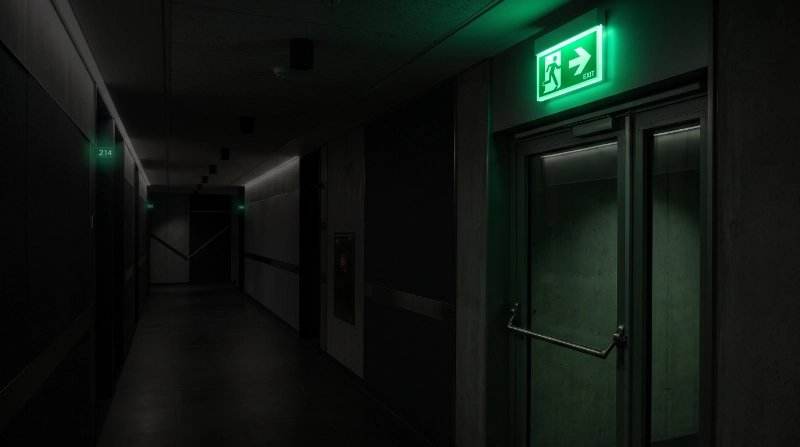
Photoluminescent Exit Signs
Photoluminescent exit signs can provide visible exit identification after normal lighting is reduced.
Depending on the jurisdiction and application, the sign may need to comply with specific design, luminance, viewing-distance and installation requirements.
For example, Singapore's Fire Code specifies requirements for exit and directional signs and separately addresses self-luminous and photoluminescent systems.
Glow Tape
Glow Tape can provide continuous low-level visual guidance along walls, floors, handrails or architectural edges.
It is particularly useful for creating a clear visual route between individual signs.
In Singapore, the Fire Code specifies photoluminescent marking/tape dimensions and low-level positioning for applicable escape routes.
For emergency routes and directional markings, Glow Safety Tape can be used to create continuous illuminated guidance along suitable floors, walls, steps and other surfaces.

Glow Stickers
Glow Stickers can be useful where removable or easily applied photoluminescent markings are required.
They can be used for arrows, symbols, identification points and other visual guidance where the substrate and product specification are appropriate.
For regulated applications, always confirm that the selected sticker or decal is approved or suitable for the intended safety purpose.
Glow Paint Markings
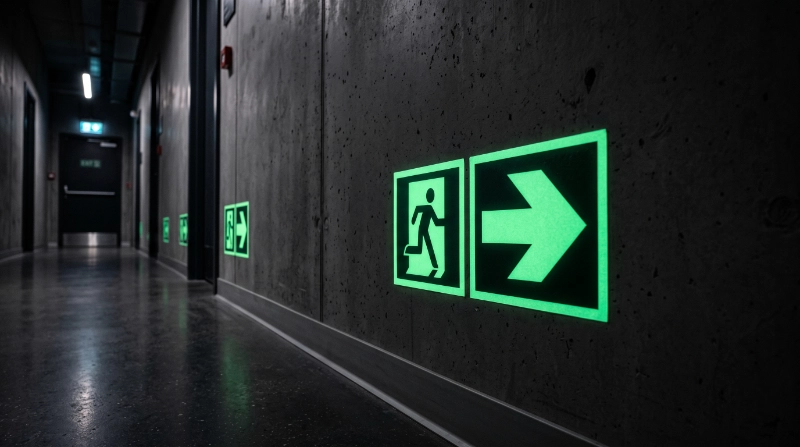
Glow Paint can be used to create photoluminescent markings on suitable surfaces.
Potential applications include:
- Low-level pathway lines
- Architectural edges
- Stair details
- Directional markings
- Large fixed-surface areas
For a regulated emergency system, however, the coating must be evaluated against the applicable performance requirements rather than being selected solely because it glows.
Stair and Handrail Markings
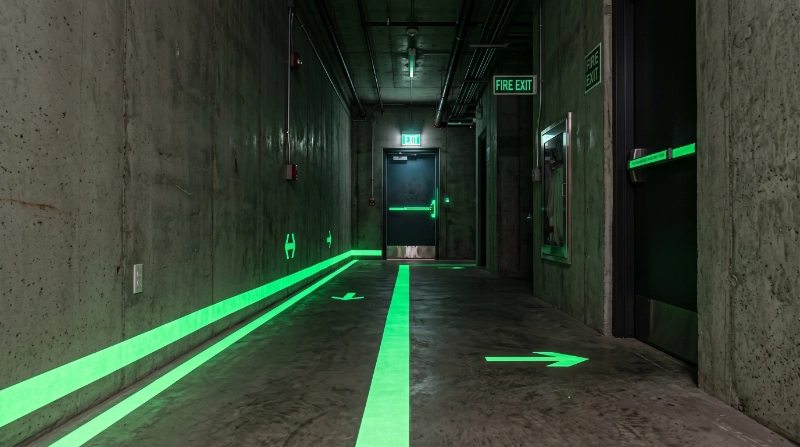
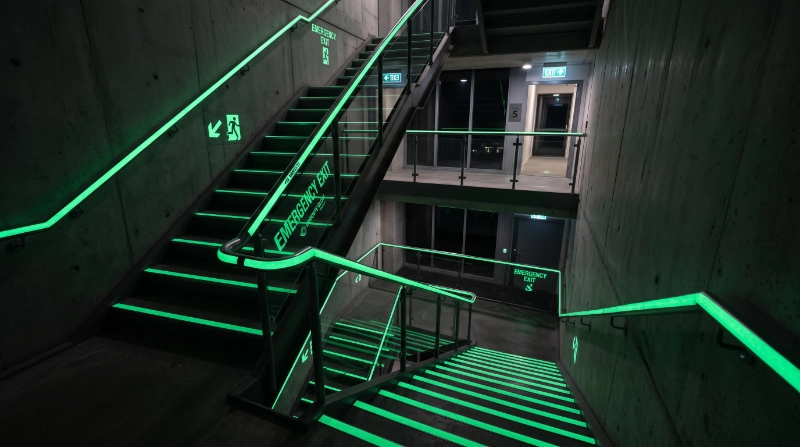
Low-level photoluminescent markings can help occupants identify stair edges, handrails and changes in level during reduced visibility.
These applications can be particularly useful in staircases where clear visual definition is important.
Stairs are an important part of an illuminated escape route. Purpose-designed Glow Stair Nosing can make stair edges easier to identify when normal lighting is unavailable.
Singapore's Fire Code specifically addresses photoluminescent markings along exit staircases and includes requirements relating to stair treads and handrails in applicable buildings.
Day vs Night Appearance
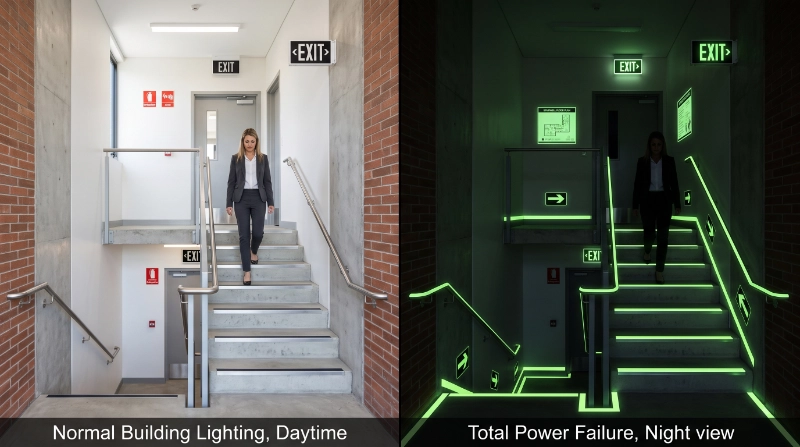
- Day Appearance
- Night Appearance
- Lighting
- Best Results
During normal lighting, photoluminescent signage should look like an intentional part of the building's safety system.
Exit signs, arrows and low-level markings should be clearly positioned and unobstructed.
The charging light is also important.
A photoluminescent product cannot perform effectively if it is installed in a permanently dark location without an appropriate charging source.
The normal lighting design should therefore be considered when planning photoluminescent emergency markings.
When normal lighting is reduced or lost, the photoluminescent material begins releasing stored energy.
This creates a visible glow that can help occupants identify the intended route.
The strongest glow occurs shortly after the charging light is removed, with brightness gradually decreasing over time.
For safety applications, the required performance should be established from the relevant standard or fire code rather than relying on visual impressions alone.
Charging light is fundamental to photoluminescent performance.
Potential charging sources include:
- Daylight
- Normal building lighting
- Suitable LED lighting
- Fluorescent lighting
- UV black lights for inspection and demonstration
A UV black light is particularly useful during application because it can rapidly reveal whether Glow Paint or other photoluminescent material has been applied consistently.
However, a permanent emergency system should be designed around its intended normal operating lighting and applicable regulations, not dependent on an operator manually charging the material.
For an effective emergency exit visibility system:
- Keep signs unobstructed.
- Use consistent directional symbols.
- Maintain a continuous visual route.
- Place low-level markings where specified.
- Ensure the charging environment is adequate.
- Use products appropriate for the substrate.
- Inspect the system periodically.
- Keep surfaces clean.
- Replace damaged or degraded markings.
- Verify performance against the applicable fire and safety requirements.
In Singapore, for example, the Fire Code specifies that photoluminescent marking/tape should be positioned at low level, with requirements for width and height in applicable situations.
Brightness Expectations
- Brightness
- Charging
- Glow Duration
- Performance Factors
The brightness of a photoluminescent safety sign depends on the quality of the material, the amount of light it receives before an emergency and the surrounding conditions.
A sign that appears bright in a dark room immediately after charging will gradually become less bright as the stored energy is released.
For emergency applications, visual brightness should not be judged solely by looking at a sample. The selected product should meet the performance requirements applicable to its intended use.
Photoluminescent products need adequate exposure to light before they can provide their glow.
Normal building lighting can provide charging, provided the lighting conditions are suitable for the specified product and installation.
The charging environment should therefore be considered during the design stage.
Do not install a photoluminescent sign in a location where architectural features, furniture or other equipment permanently block the charging light.
Glow gradually decreases after the charging source is removed.
The rate of reduction depends on:
- Product formulation.
- Initial charging level.
- Charging duration.
- Ambient temperature.
- Surrounding darkness.
- Surface condition.
- Age and condition of the product.
For regulated emergency applications, specify products according to their tested performance rather than promising a particular glow duration based on general observations.
| Factor | Effect |
|---|
| Adequate charging light | Improves photoluminescent performance |
| High-quality material | Provides more consistent performance |
| Clean surface | Maintains visibility |
| Correct installation | Helps maintain the intended guidance system |
| Low ambient light | Makes the glow easier to see |
| Dirt or contamination | Can reduce visibility |
| Physical damage | May interrupt the visual route |
| Ageing | Can affect appearance and performance |
Choosing Products
| Product | Best For | Location | Difficulty | Notes |
|---|---|---|---|---|
| Glow Stickers | Exit symbols, arrows and identification points | Indoor/Outdoor | Easy | Useful for quick installation on suitable clean surfaces. |
| Glow Tape | Continuous low-level route marking and edges | Indoor/Outdoor | Easy | Useful for creating continuous visual guidance. |
| Glow Paint | Permanent markings on suitable walls and surfaces | Indoor/Outdoor | Hard | Suitable where a painted photoluminescent finish is preferred. |
| Primer | Base preparation beneath Glow Paint | Indoor/Outdoor | Hard | Use where required by the selected coating system. |
*Indoor/Outdoor Suitability depends on the specific product, substrate and environmental exposure.
Recommended Products
For a photoluminescent emergency exit system, the most suitable Darknite Glow products may include:
- Glow Stickers — for signs, arrows and identification points.
- Glow Tape — for continuous low-level markings.
- Glow Paint — for larger permanent markings on suitable surfaces.
- Glow Primer — where required for the Glow Paint system.
Selecting the Right Format
The product should be selected according to the purpose of the marking.
The right material depends on the application. Glow Paint is useful for direct surface application, while Glow Powder can be mixed into compatible materials such as resin and concrete.
Use Glow Stickers when:
- A ready-made symbol or arrow is required.
- Installation needs to be quick.
- The substrate is suitable for adhesive application.
Use Glow Tape when:
- A continuous line is required.
- A route needs to be visually connected.
- Low-level wall or edge marking is appropriate.
Use Glow Paint when:
- A permanent painted finish is preferred.
- The design requires custom shapes or markings.
- A large surface needs to be treated.
For regulated emergency applications, always verify that the selected product and installation method comply with the applicable local requirements.
Surface Preparation & Application
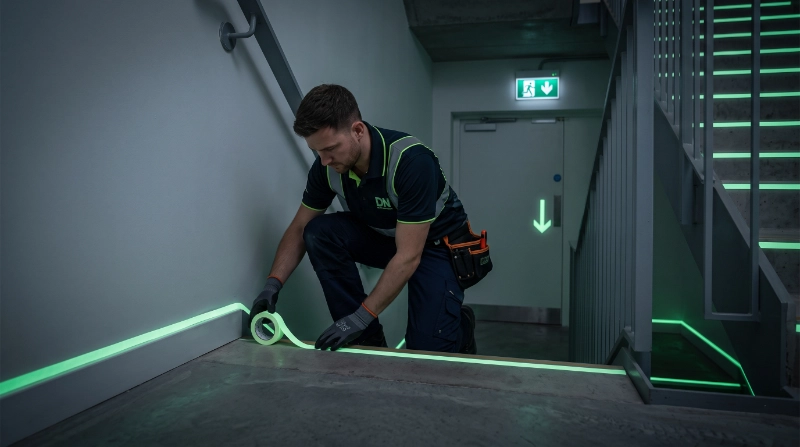
Surface Preparation
The substrate must be clean, dry and suitable for the selected product.
Before installation:
- Remove dust and dirt.
- Remove grease and oil.
- Remove loose paint.
- Repair damaged surfaces.
- Ensure adhesive surfaces are dry.
- Remove existing material that could interfere with adhesion.
- Check that the surface is compatible with the selected product.
For painted applications, the existing coating should be firmly bonded and suitably prepared.
For Glow Stickers and Glow Tape, the adhesive surface is particularly important because poor adhesion can cause sections of the escape route marking to detach.
Materials Needed
Depending on the system, you may need:
- Glow Stickers
- Glow Tape
- Glow Paint
- Glow Primer
- Measuring tools
- Masking tape
- Cleaning materials
- Rollers and brushes
- Suitable cutting tools
- UV black light for inspection
- Appropriate protective equipment
Application Steps
- Inspect the escape route and identify all required markings.
- Check the applicable fire and building requirements.
- Measure and mark the intended positions.
- Clean and prepare the substrate.
- Apply Glow Primer where required.
- Install Glow Stickers or Glow Tape carefully, avoiding wrinkles and air pockets.
- Apply Glow Paint according to the manufacturer's instructions where a painted system is being used.
- Allow coatings to dry and cure fully.Inspect the complete route under normal lighting.
- Inspect the route under reduced lighting.
- Use a UV black light to check Glow Paint coverage where appropriate.
- Correct damaged, missing or uneven sections.
- Document the completed installation for future inspection and maintenance.
Professional Tips
Professional Tip
During application, periodically switch off the lights and inspect your work using a UV black light. This reveals missed areas, uneven coverage and ensures the best glow performance. The same technique is recommended for UV reactive paints as the black light immediately reveals the finished effect.
For large buildings, do not inspect individual signs in isolation. Walk the entire escape route from occupied areas towards the final exit.
The objective is to create a continuous and easily understood visual path.
Safety Notes
- Do not obstruct required exit signs or emergency equipment.
- Follow local fire-safety requirements.
- Use appropriate access equipment when working at height.
- Wear gloves where appropriate.
- Ensure painted areas are fully cured before normal building use.
- Never shine UV lights directly into the eyes.
- Do not treat decorative Glow Paint as automatically compliant emergency signage.
- Have regulated installations inspected or approved where required.
Common Mistakes
Treating Glow Products as a Complete Emergency Lighting System
Why it happens:
Photoluminescent products can remain visible after a power failure, which may lead to the assumption that they replace emergency lighting.
How to avoid it:
Use them as part of a properly designed safety system and check the applicable regulations.
Installing Signs Without Considering the Escape Route
Why it happens:
Individual signs may look correct while the route between them remains unclear.
How to avoid it:
Walk the complete route and ensure the signs and markings provide continuous visual guidance.
Blocking the Charging Lights
Why it happens:
Signs or markings are installed behind furniture, equipment or architectural features.
How to avoid it:
Check that the photoluminescent material receives sufficient normal lighting.
Using the Wrong Product for the Surface
Why it happens:
An adhesive product may be applied to a surface that is dusty, oily, damp or unsuitable.
How to avoid it:
Check substrate compatibility and prepare the surface correctly.
Poor Adhesion of Glow Tape or Stickers
Why it happens:
The substrate has not been properly cleaned or the adhesive is applied incorrectly.
How to avoid it:
Clean and dry the surface thoroughly and follow the manufacturer's application instructions.
Inconsistent Marking Positions
Why it happens:
Different installers position markings at different heights or distances.
How to avoid it:
Create a clear installation plan and use consistent measurements throughout the project.
Ignoring Maintenance
Why it happens:
Photoluminescent products do not require electrical power, so they may be overlooked during inspections.
How to avoid it:
Inspect signs and markings regularly for dirt, damage, peeling, fading and obstruction.
Assuming All Glow Products Have the Same Performance
Why it happens:
Different photoluminescent materials can look similar under normal lighting.
How to avoid it:
Check the technical specifications and tested performance of the actual product being specified.
Key Takeaways
- Glow in the dark safety signs can provide additional visual guidance when normal lighting is reduced or lost.
- Photoluminescent products need adequate charging light to perform effectively.
- Glow Stickers and Glow Tape provide convenient options for signs, arrows and continuous route markings.
- Glow Paint can be used for larger or customised permanent markings on suitable surfaces.
- Emergency exit systems should provide a continuous and easy-to-follow visual route.
- Photoluminescent products should complement, rather than automatically replace, required emergency lighting and exit systems.
- Regular inspection and maintenance are important to keep signs visible and effective.
- Always check local fire-safety regulations before specifying products for a regulated emergency application.
Other Safety Applications
Emergency exit systems are part of a wider range of photoluminescent safety applications. See our Glow in the Dark Road Markings Guide and Glow in the Dark Safety Signs Guide for additional applications.
Looking for more glow-in-the-dark ideas,
techniques and applications?
Explore our complete guide.