Glow in the Dark Stair Nosings
A practical guide to photoluminescent stair edges, L-shaped nosings and flat aluminium glow strips for stairs, walkways and driveways.
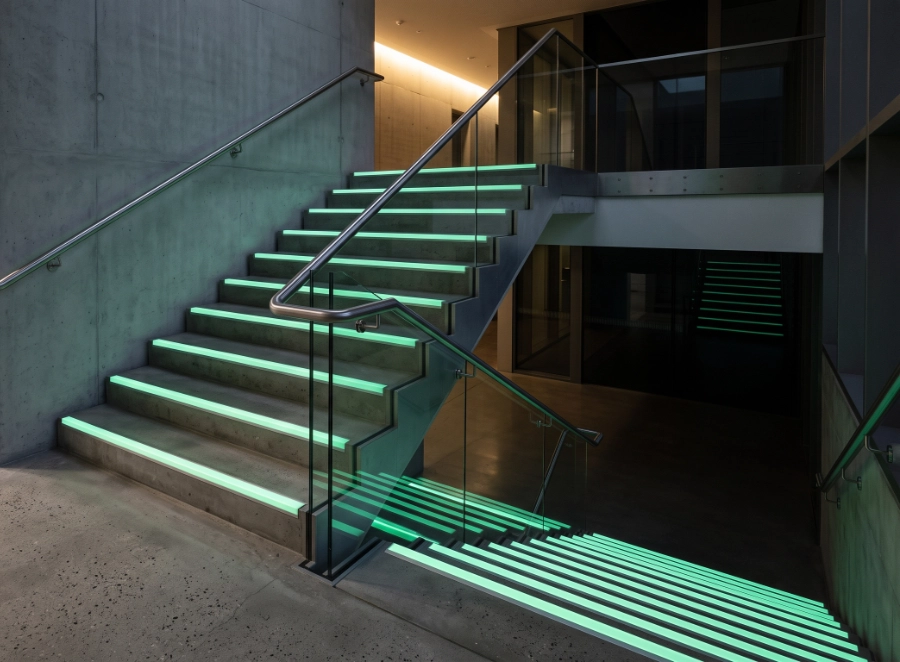
Why Use Glow in the Dark Stair Nosings?
Stair edges can become difficult to see when lighting is reduced. This is particularly important in commercial buildings, public areas, entertainment venues, industrial facilities and emergency escape routes.
Glow in the Dark Stair Nosings provide a clearly defined visual edge by incorporating a photoluminescent section into a stair nosing or strip.
During normal lighting, the nosing appears as part of the stair finish. When the surrounding light is reduced, the photoluminescent section produces a visible glow that helps distinguish one step from another.
This can provide an additional visual cue for people using the staircase.
The concept is simple: make the leading edge of every step easier to identify when conventional lighting is reduced.
A visible stair edge can be particularly important when normal lighting is reduced or unavailable. Glow Stair Nosing provides a dedicated solution, while Glow Safety Tape can be considered for simpler marking applications.
In Singapore, the Fire Code specifically illustrates a photoluminescent nose strip at the leading edge of a stair riser and states that the strip shall be at least 50 mm wide in the applicable fire-safety context.
However, a commercially available glow stair nosing should not automatically be assumed to satisfy every building-code requirement. The product, dimensions, installation and overall emergency lighting system must be assessed for the particular project.
Benefits
Glow stair nosings can provide:
- Clearer definition of stair edges.
- Additional visibility in low-light conditions.
- A continuous visual line down a staircase.
- Improved identification of individual steps.
- A professional architectural finish.
- A passive photoluminescent safety feature.
- A practical solution for commercial and industrial applications.
- Potential use beyond stairs on suitable walkways and driveways.
They can also be combined with other photoluminescent products to create a more complete low-level visual guidance system.
Typical Uses
Glow stair nosings are suitable for consideration in:
- Commercial staircases
- Office buildings
- Shopping centres
- Hotels
- Industrial facilities
- Warehouses
- Car parks
- Public buildings
- Entertainment venues
- Residential staircases
- Emergency escape staircases
- Outdoor steps
- Walkways
- Driveways
For regulated escape routes, always check the applicable requirements before specifying the product.
How Glow in the Dark Stair Nosings Work
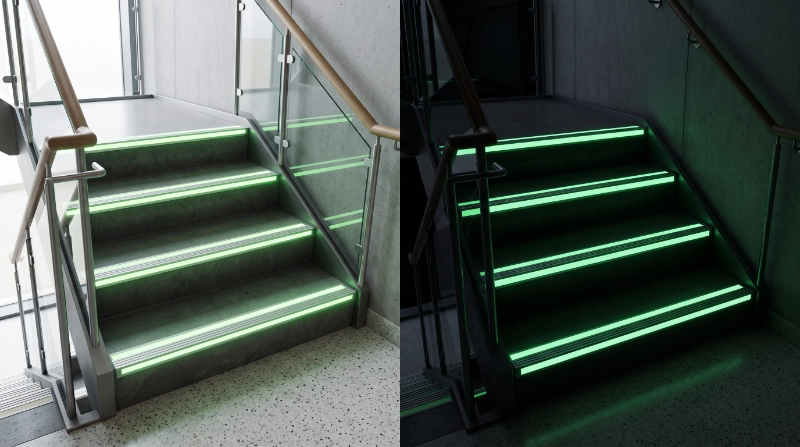
- How It Works
- Key Facts
- Advantages
- Professional Tip
A photoluminescent stair nosing contains a glow-producing material that absorbs energy from surrounding light.
During normal operation, daylight or artificial lighting charges the photoluminescent material.
When the lights are reduced or switched off, the stored energy is gradually released as visible light.
The glow highlights the leading edge of the stair.
This is particularly useful because the edge of each step remains visually defined even when the surrounding staircase becomes much darker.
The aluminium profile provides the physical structure, while the photoluminescent section provides the glow.
- Photoluminescent materials require light to charge.
- The glow becomes visible when surrounding light is reduced.
- Brightness gradually decreases after charging.
- Charging conditions affect performance.
- Clean, unobstructed nosings provide better visibility.
- The substrate and installation method affect durability.
- Product dimensions should be selected according to the application.
- Building-code requirements may apply to emergency escape staircases.
Singapore's Fire Code currently includes specific requirements for photoluminescent marking in applicable buildings and illustrates photoluminescent nose strips at stair edges.
Improved Step Definition
The glowing edge creates a strong visual reference between individual steps.
Continuous Guidance
Installing the nosing consistently on every step creates a continuous line of visual guidance.
Low-Level Visibility
Because the product is positioned directly at the stair edge, it provides visibility close to the floor.
Passive Operation
Photoluminescent materials do not require a continuous electrical connection to produce their basic glow.
Architectural Appearance
Aluminium profiles can provide a neat, durable finish suitable for modern commercial interiors.
Versatile Applications
Depending on the profile, flat photoluminescent aluminium strips can also be used on suitable walkways and driveways.
Professional Tip
During application, periodically switch off the lights and inspect your work using a UV black light. This reveals missed areas, uneven coverage and ensures the best glow performance. The same technique is recommended for UV reactive paints as the black light immediately reveals the finished effect.
For stair nosings, inspect the complete staircase rather than checking only one or two steps. The objective is to achieve a consistent visual line from the top to the bottom of the staircase.
Types of Glow in the Dark Stair Nosings
L-Shaped Glow Stair Nosings
An L-shaped stair nosing is the preferred format when the product needs to follow the front edge of a conventional stair.
The profile can cover the leading edge and provide a defined photoluminescent strip along the step.
This format is particularly suitable for:
- Concrete stairs
- Stone stairs
- Tiled stairs
- Commercial staircases
- Industrial staircases
- Emergency escape stairs
For stairs, an L-shaped profile generally provides a more purposeful stair-edge installation than simply placing a flat strip on the horizontal tread.
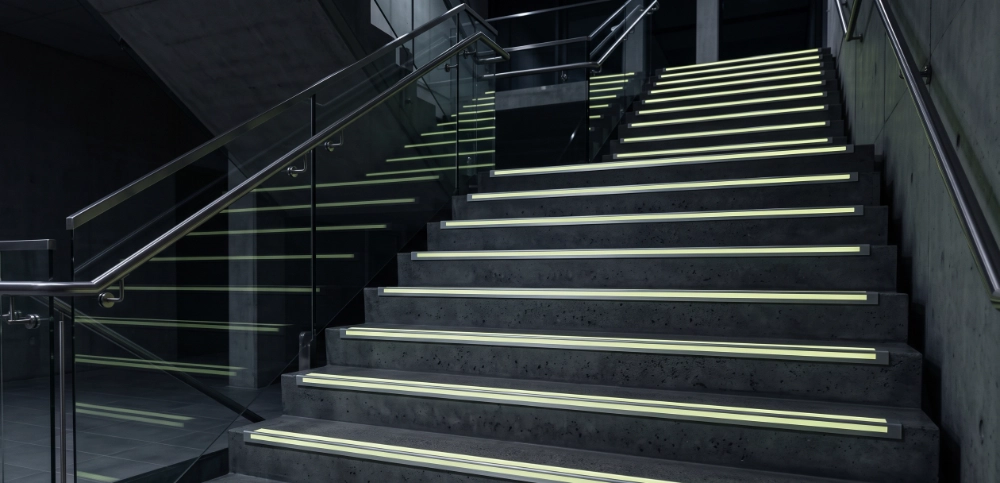
Flat Aluminium Photoluminescent Strips
A flat aluminium plate with a photoluminescent surface provides a simple linear marking option.
Darknite Glow offers a 50 mm × 1 metre flat aluminium format that can be considered for suitable stairs as well as walkways and driveways.
The flat profile is particularly useful where a flush or surface-mounted strip is preferred.
It can also provide a practical visual line along pedestrian routes.
For stair applications, however, the installation must be assessed carefully to ensure that the strip does not create a trip hazard or interfere with the stair geometry.
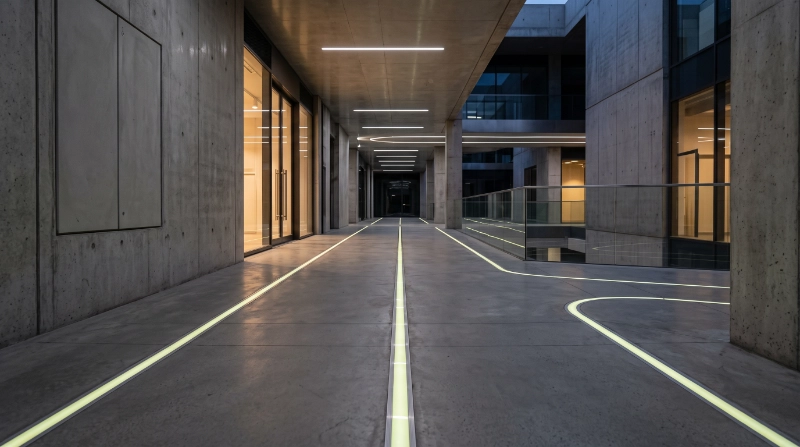
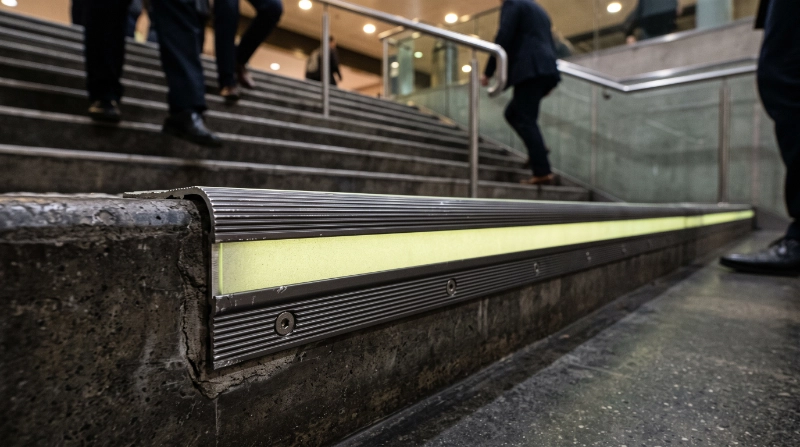
Photoluminescent Stair-Edge Profiles
Purpose-designed stair-edge profiles combine a physical aluminium profile with a photoluminescent section.
They are useful where both edge definition and mechanical protection are desirable.
The profile can help protect the stair edge from everyday wear while the photoluminescent element provides the visible glow.
This makes the format particularly appropriate for heavily used commercial or industrial staircases.
Walkway and Driveway Marking Strips
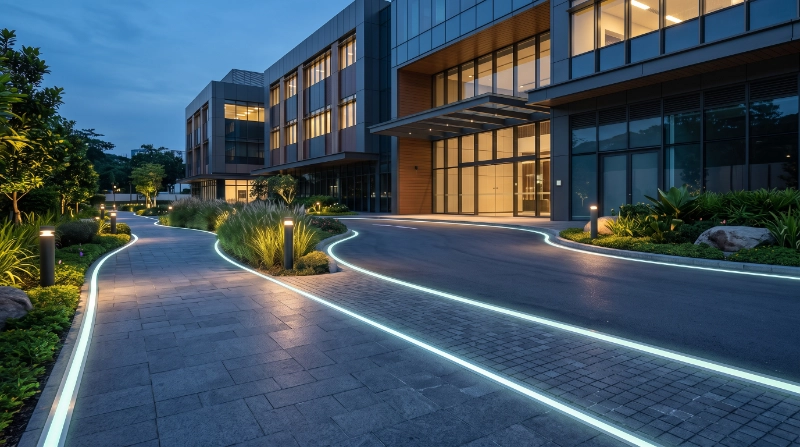
Flat aluminium photoluminescent strips do not have to be limited to stairs.
Suitable flat profiles can also be used to create visual guidance on:
- Walkways
- Pedestrian routes
- Driveways
- Ramps
- Thresholds
- Outdoor paths
The suitability of an installation depends on traffic, surface conditions, weather exposure, fixing method and the particular product specification.
For vehicle areas, the strip must be selected and installed with the expected loading and traffic conditions in mind.
Day vs Night Appearance
- Day Appearance
- Night Appearance
- Lighting
- Best Results
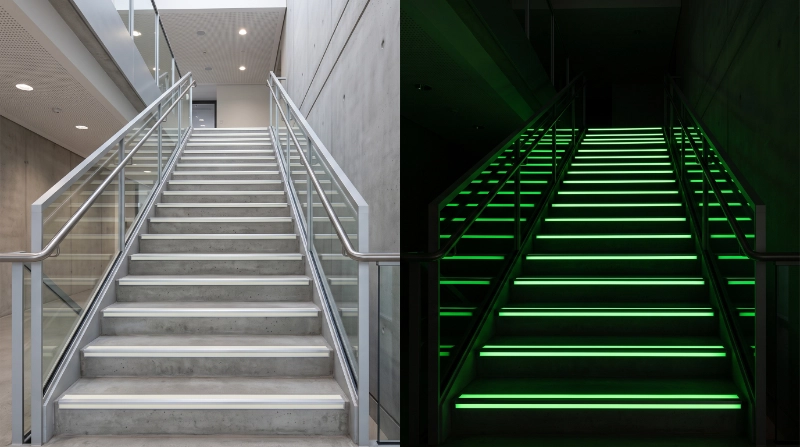
Under normal lighting, the aluminium stair nosing provides a clean architectural finish while the photoluminescent section remains integrated into the profile.
The staircase should look neat and consistent, with every nosing installed at the same position and alignment.
This consistency is particularly important on long staircases.
Uneven positioning can make the staircase look untidy and may reduce the effectiveness of the visual guidance.
When the surrounding lighting becomes dark, the photoluminescent section begins to glow.
The result is a series of visible lines following the leading edge of each stair.
This can make the staircase geometry easier to understand and helps distinguish individual steps.
The strongest glow normally occurs after adequate charging, then gradually decreases.
Actual brightness depends on the product, charging conditions, surrounding darkness and environmental conditions.
The normal lighting environment is an important part of any photoluminescent installation.
A stair nosing needs to receive sufficient light during normal operation to charge the photoluminescent material.
Potential charging sources include:
- Daylight
- LED lighting
- Fluorescent lighting
- Suitable artificial lighting
However, the permanent installation should be designed around the building's normal lighting conditions and applicable requirements.
For consistent performance:
- Install the nosings at the same position on every step.
- Keep the photoluminescent surface clean.
- Ensure adequate charging light.
- Avoid covering the glowing section.
- Use a suitable fixing method for the substrate.
- Check that the profile does not create a trip hazard.
- Inspect the entire staircase after installation.
- Replace damaged or badly worn sections.
- Consider viewing distance and staircase configuration.
For regulated emergency escape stairs, the product should be assessed against the applicable fire-safety requirements.
In Singapore, the Fire Code currently specifies photoluminescent marking/tape provisions for evacuation routes and illustrates a photoluminescent nose strip at the leading edge of stair risers.
Brightness Expectations
- Brightness
- Charging
- Glow Duration
- Performance Factors
The brightness of photoluminescent stair nosings depends on the photoluminescent material, charging conditions and surrounding environment.
A high-quality nosing should provide a clearly visible glow after adequate exposure to light, but brightness is not constant. It is normally strongest shortly after the charging light is removed and gradually decreases.
For a regulated safety application, performance should be based on the product's technical data and the applicable building or fire-safety requirements rather than appearance alone.
Singapore's Fire Code gives a useful performance guide for photoluminescent marking/tape of at least 800 mcd/m² at 1 minute after the light source is removed, at least 80 mcd/m² at 10 minutes, and remaining visible at 1 mcd/m² after 6 hours. These figures relate to the Code's photoluminescent marking/tape provision and should not automatically be treated as a specification for every commercially available stair nosing.
hotoluminescent stair nosings need sufficient light during normal conditions.
Suitable charging sources may include:
- Daylight
- LED lighting
- Fluorescent lighting
- Other suitable artificial lighting
The staircase should be assessed under its actual normal lighting conditions.
A nosing positioned in a permanently shaded area may not charge as effectively as one exposed to stronger illumination.
A UV black light is useful for installation checks and demonstrations, but it should not be assumed to be the permanent charging source for an emergency installation.
The glow gradually decreases after the charging source is removed.
Performance is influenced by:
- Initial charging level
- Charging duration
- Photoluminescent material
- Ambient temperature
- Surrounding darkness
- Age of the product
- Surface cleanliness
For professional projects, specify the product according to documented performance rather than making a generic claim that all glow stair nosings will remain equally bright for a particular number of hours.
| Factor | Effect |
|---|---|
| Adequate charging light | Helps maximise initial brightness |
| High-quality photoluminescent material | Provides more consistent performance |
| Clean surface | Helps maintain visibility |
| Correct installation | Maintains a consistent visual route |
| Dark surroundings | Makes the glow more noticeable |
| Dirt or contamination | Can reduce visible brightness |
| Heavy wear | Can damage the photoluminescent section |
| Obstruction | Can reduce visibility and charging |
Choosing the Right Stair Nosing
| Product | Best For | Location | Difficulty | Notes |
|---|---|---|---|---|
| L-Shaped Glow Stair Nosing | Staircases and step edges | Indoor/Outdoor | Hard | Preferred format for clearly defining the leading edge of a stair. |
| Flat Aluminium Glow Plate | Walkways, driveways and suitable stairs | Indoor/Outdoor | Hard | 50 mm × 1 metre format; assess fixing and traffic conditions carefully. |
| Photoluminescent Stair-Edge Profile Tape | DIY | Indoor | Easy | Useful where a profile is unsuitable |
*Outdoor use depends on the product specification, substrate, weather exposure, fixing method and expected traffic.
Product Dimensions
For Darknite Glow's product range, the key formats to consider include:
- Flat aluminium plate: 50 mm × 1 metre.
- Maximum available length: 1.24 metres.
- L-shaped profile: designed specifically for installation around the leading edge of stairs.
Longer runs can be achieved by installing multiple sections end-to-end, provided the joints are neat, secure and appropriate for the application.
Recommended Products
For most stair applications, the preferred choice is:
- L-Shaped Glow Stair Nosings — best suited to conventional stair edges.
- Flat Aluminium Photoluminescent Strips — useful for walkways, driveways and suitable flat applications.
- Glow Paint — an alternative where custom painted markings are required.
For permanent stair-edge visibility, Glow Stair Nosing provides a purpose-designed solution for highlighting stair edges in low-light and dark environments.
Where a full stair nosing system is not required, Glow Safety Tape can provide a simpler way to mark stair edges and improve visibility in low-light conditions.
For a regulated emergency staircase, product selection should be reviewed against the applicable fire-safety requirements.
In Singapore, the current Fire Code specifically requires photoluminescent marking/tape to be at least 50 mm wide and positioned at low level in the applicable applications. It also specifically illustrates a photoluminescent nose strip at the leading edge of each stair rise.
Surface Preparation & Application
Surface Preparation
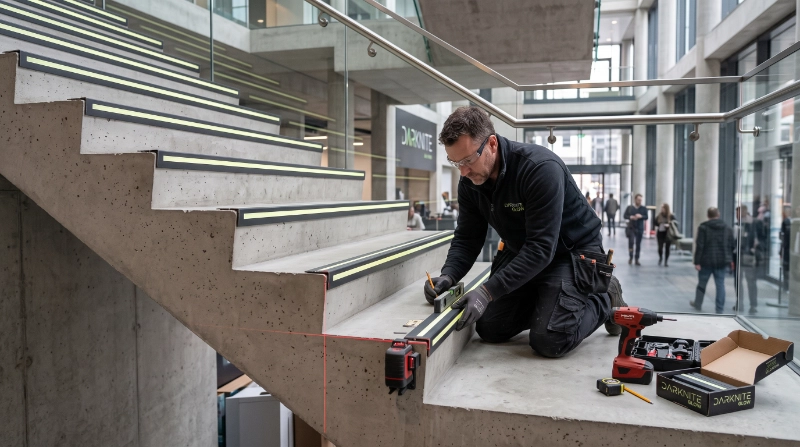
The substrate must be clean, dry and structurally sound.
Before installation:
- Remove dust and loose material.
- Remove grease, oil and contamination.
- Repair damaged stair edges.
- Remove loose paint or coatings.
- Check that the stair surface is level and suitable.
- Confirm the fixing method is appropriate for the substrate.
For heavily used stairs, pay particular attention to the condition of the leading edge.
The stair nosing should sit securely and should not create a raised edge that introduces a trip hazard.
Materials Needed
Depending on the installation method:
- Glow Stair Nosings
- Flat aluminium photoluminescent strips
- Appropriate adhesive or mechanical fixings
- Measuring tape
- Straight edge
- Cleaning materials
- Suitable drill and fasteners where required
- Cutting equipment where appropriate
- Masking tape
- UV black light
- Gloves and appropriate PPE
Always follow the fixing requirements for the specific product.
Application Steps
L-Shaped Stair Nosing
- Measure each stair.
- Confirm the required nosing length.
- Clean and prepare the stair edge.
- Check that the profile sits correctly.
- Cut the section only if permitted by the product design.
- Apply the specified adhesive or fixing system.
- Position the nosing accurately along the leading edge.
- Press or secure it firmly according to the installation method.
- Check that the profile is straight and level.
- Allow adhesive or coating systems to cure fully where applicable.
- Repeat consistently on every stair.
- Inspect the complete staircase under normal and low-light conditions.
Flat Aluminium Strip
For a flat 50 mm × 1 metre strip:
- Measure the intended route.
- Mark the installation line.
- Clean and dry the surface.
- Confirm the strip will sit securely.
- Apply the appropriate fixing method.
- Ensure there are no loose edges or raised corners.
- Check the completed route for trip hazards.
- Inspect the strip under low-light conditions.
Professional Tips
During application, periodically switch off the lights and inspect your work using a UV black light. This reveals missed areas, uneven coverage and ensures the best glow performance. The same technique is recommended for UV reactive paints as the black light immediately reveals the finished effect.
For a long staircase, use a consistent reference point for every step.
Do not rely on visual estimation alone. Small variations in height or position become very noticeable when viewed along a long flight of stairs.
Emergency Escape Routes
Stair visibility is only one part of an effective emergency route. For a broader approach to photoluminescent escape guidance, see our [Complete Guide on Glow in the Dark Emergency Exit Systems].
Safety Notes
- Ensure the nosing does not create a trip hazard.
- Use non-slip materials where required.
- Make sure the fixing system is suitable for the substrate.
- Do not leave loose edges or corners.
- Follow adhesive curing requirements.
- Wear gloves where appropriate.
- Use suitable access equipment when working at height.
- For regulated escape stairs, confirm requirements with the relevant Qualified Person or authority.
Singapore's Fire Code states that photoluminescent nose strips should be made from materials that are non-skid and able to resist abrasion and wear.
Common Mistakes
Using a Flat Strip Where an L-Shaped Nosing Is More Suitable
Why it happens:
A flat aluminium strip can be easier to install, so it may be selected without considering the geometry of the stair.
How to avoid it:
Use an L-shaped stair nosing where a profile that follows the leading edge provides a better fit and finish.
Installing Different Nosings at Different Heights
Why it happens:
Each stair is measured individually without a consistent reference.
How to avoid it:
Establish a fixed installation position and use the same reference measurement throughout the staircase.
Poor Surface Preparation
Why it happens:
Dust, grease, loose coatings or moisture prevent proper adhesion.
How to avoid it:
Clean and dry the substrate thoroughly before installation.
Creating a Trip Hazard
Why it happens:
The profile is raised, loose or incorrectly positioned.
How to avoid it:
Check the finished installation from several angles and ensure the nosing sits securely without creating an unsafe projection.
Using a Product That Is Not Suitable for Heavy Wear
Why it happens:
The visual appearance of a product is considered without considering the amount of foot traffic.
How to avoid it:
For commercial or industrial stairs, select a profile and photoluminescent material designed for the expected abrasion and wear.
Ignoring the Charging Environment
Why it happens:
The staircase looks adequately lit during installation but the photoluminescent material receives insufficient light during normal operation.
How to avoid it:
Assess the actual lighting conditions throughout the staircase.
Assuming a Glow Nosing Automatically Meets Building Regulations
Why it happens:
The product glows visibly, so it may appear to be compliant.
How to avoid it:
Check the product's technical specifications and the requirements applicable to the building and intended use.
Forgetting Maintenance
Why it happens:
Photoluminescent products have no electrical components and can therefore be overlooked.
How to avoid it:
Inspect them periodically for dirt, damage, loose sections and excessive wear.
Key Takeaways
Highlight Box
- Glow in the Dark Stair Nosings make stair edges easier to identify when surrounding lighting is reduced.
- L-shaped profiles are generally the preferred format for conventional stair-edge applications.
- Flat 50 mm × 1 metre aluminium strips can provide an alternative for suitable stairs and are particularly useful for walkways and driveways.
- Darknite Glow stair nosings are available in lengths up to approximately 1.24 metres, depending on the product.
- Photoluminescent materials need adequate charging light to perform effectively.
- Stair nosings should be secure, non-slip and resistant to the expected wear and abrasion.
- Installation should be consistent across the entire staircase.
- For regulated emergency applications, always check the applicable building and fire-safety requirements before specifying the product.
Looking for more glow-in-the-dark ideas,
techniques and applications?
Explore our complete guide.