How Glow in the Dark Materials Work
Glow in the dark materials have fascinated people for decades. They are used in everything from children's stickers and decorative products to emergency escape signs, industrial safety markings, plastics, coatings, and specialty applications.
Unlike ordinary fluorescent colours that only shine under ultraviolet (UV) light, glow in the dark materials continue to emit visible light after the light source has been removed. This unique property is known as photoluminescence.
Modern glow materials are safer, brighter, and significantly longer lasting than earlier generations, making them suitable for both decorative and industrial applications.
Whether you are using glow in the dark powder, paint, or stickers, understanding how these materials work helps you choose the right product for your project.
What Is Glow in the Dark?
Glow in the dark refers to materials that absorb energy from a light source and slowly release that stored energy as visible light after the light source is removed.
This process is called phosphorescence, which is one form of photoluminescence.
Unlike batteries or LEDs, glow materials require no electrical power. They simply need exposure to an appropriate light source.
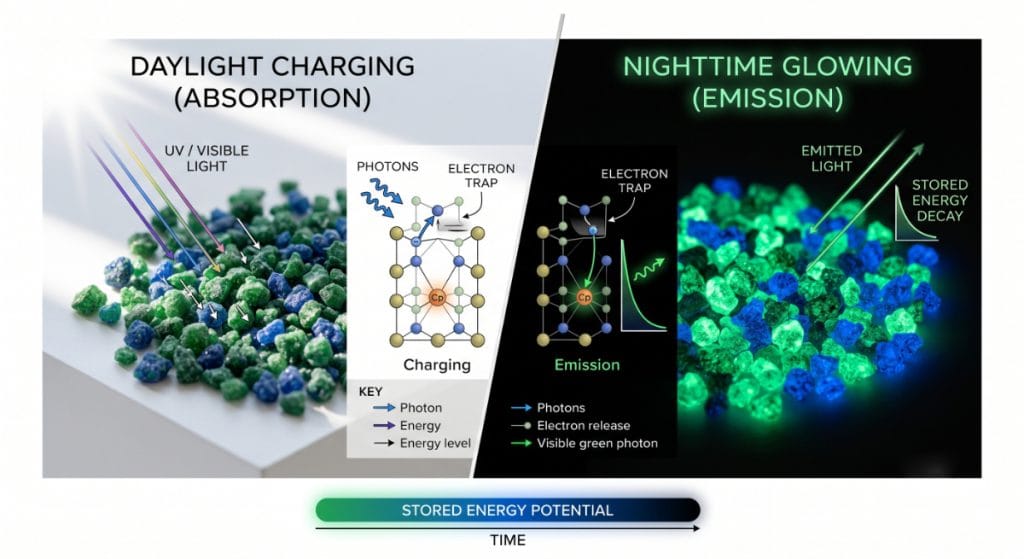
Basic Process
| Step | What Happens |
|---|---|
| Light exposure | Pigment absorbs energy |
| Energy storage | Electrons store the absorbed energy |
| Darkness | Stored energy is gradually released |
| Visible glow | Material emits light until energy is depleted |
Did You Know?
Modern strontium aluminate pigments can glow over ten times brighter and much longer than older zinc sulfide pigments.
How It Works
The Science Behind Photoluminescence
Glow in the dark pigments contain microscopic crystals that temporarily trap energy from light.
When exposed to:
- Sunlight
- LED lighting
- Fluorescent lighting
- UV light
the pigment absorbs photons.
The absorbed energy excites electrons inside the crystal structure.
Instead of immediately releasing the energy, the crystal traps some of these electrons in special energy states.
As the electrons slowly return to their normal state, they release visible light.
This slow release creates the familiar glow.
Simplified Process
Light Source
      ↓
Pigment absorbs energy
      ↓
Energy stored inside crystal
      ↓
Light source removed
      ↓
Stored energy slowly released
      ↓
Visible Glow
Why Does the Glow Fade?
The pigment stores a limited amount of energy.
As this energy is released:
- brightness gradually decreases
- glow becomes dimmer
- eventually no stored energy remains
The pigment must then be recharged.
What Determines Glow Performance?
Several factors influence how well glow materials perform.
| Factor | Effect |
|---|---|
| Pigment quality | Higher quality = brighter glow |
| Pigment concentration | More pigment = brighter result |
| Particle size | Larger particles generally glow longer |
| Charging light intensity | Stronger light stores more energy |
| Charging time | Longer exposure increases brightness |
| Colour | Green usually glows brightest |
| Binder transparency | Clear binders improve performance |
Important
Glow pigments do not create light continuously. They only release previously stored energy.
Types of Glow in the Dark Materials
Comparison Table
| Type | Brightness | Glow Duration | Typical Uses |
|---|---|---|---|
| Zinc Sulfide | Low | Minutes to 1 hour | Toys, novelty items |
| Strontium Aluminate | Very High | Up to 12+ hours | Safety signs, coatings, industrial products |
Modern commercial products almost exclusively use strontium aluminate due to its superior performance.
Common Glow Colours
| Colour | Brightness | Duration |
|---|---|---|
| Green | Excellent | Excellent |
| Aqua | Excellent | Excellent |
| Blue | Very Good | Very Good |
| Yellow-Green | Very High | Excellent |
| Violet | Moderate | Moderate |
| Orange | Lower | Moderate |
| Red | Lower | Shorter |
Green remains the industry benchmark for maximum brightness.
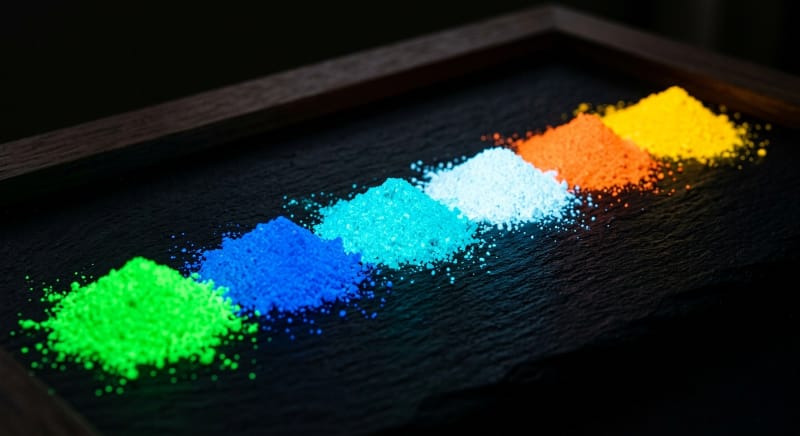
Glow in the Dark Powder
Glow powder is the raw pigment used to manufacture many products.
Common applications include:
- epoxy resin
- plastics
- paints
- printing inks
- ceramics
- concrete
- silicone
- rubber
- coatings
Typical Particle Sizes
| Grade | Particle Size | Applications |
|---|---|---|
| Fine | 5–15 µm | Printing inks |
| Medium | 15–35 µm | Paints |
| Standard | 30–50 µm | General coatings |
| Coarse | 50–100 µm | Plastics, castings |
Larger particles generally produce brighter and longer-lasting glow but may affect surface smoothness.
Pro Tip
Choose the largest practical particle size for maximum glow unless a smooth surface finish is essential.
Glow in the Dark Paint
Glow paint combines photoluminescent pigment with a transparent binder.
Suitable binders include:
- Acrylic
- Polyurethane
- Epoxy
- Water-based coatings
- Solvent-based coatings
Paint Compatibility
| Paint Type | Suitable |
|---|---|
| Acrylic | ✔ Excellent |
| Polyurethane | ✔ Excellent |
| Epoxy | ✔ Excellent |
| Clear lacquer | ✔ Good |
| Transparent resin | ✔ Excellent |
| Opaque paint | ✖ Poor |
Opaque paints block emitted light and reduce glow performance.

Glow in the Dark Stickers
Glow stickers typically consist of:
- photoluminescent film
- pressure-sensitive adhesive
- protective surface layer
Common applications include:
- bedroom decorations
- educational products
- emergency exit marking
- stair markings
- pathway guidance
- switch labels
Industrial-grade glow films comply with international safety standards for emergency escape systems.
Advantages
- No electricity required
- Rechargeable thousands of times
- Environmentally friendly
- Long service life
- Low maintenance
- Reliable during power failures
- Suitable for indoor and outdoor use
- Available in many colours
- Can be incorporated into numerous materials
Limitations
- Requires charging from a light source
- Glow gradually fades over time
- Brightness depends on pigment quality
- Dark pigments reduce performance
- Thick opaque coatings reduce effectiveness
- Lower brightness than electrically powered lighting
- Some colours naturally glow less brightly
Safety Note
Modern strontium aluminate pigments are generally non-radioactive. Historic glow products containing radioactive materials are no longer used for general commercial applications.
Applications
| Industry | Application | Benefits |
|---|---|---|
| Safety | Exit signs | Emergency visibility |
| Construction | Stair markings | Improved evacuation |
| Marine | Deck markings | Low-light guidance |
| Aerospace | Cabin markings | Passenger safety |
| Automotive | Interior trim | Decorative effects |
| Plastics | Injection moulding | Permanent glow |
| Printing | Labels | Night visibility |
| Home Décor | Wall art | Decorative lighting |
| Education | Teaching aids | Interactive learning |
| Toys | Novelty products | Fun visual effects |
| Apparel | Logos | Fashion enhancement |
| Industrial | Equipment markings | Easy identification |
Plastic Compatibility
| Plastic | Suitable |
|---|---|
| Polypropylene (PP) | ✔ |
| Polyethylene (PE) | ✔ |
| ABS | ✔ |
| PVC | ✔ |
| TPU | ✔ |
| Silicone | ✔ |
| Epoxy Resin | ✔ |
| Polyester Resin | ✔ |
Indoor vs Outdoor Performance
| Environment | Performance |
|---|---|
| Indoor | Excellent |
| Outdoor covered | Very Good |
| Outdoor exposed | Good with UV-stable binders |
| High humidity | Good when properly sealed |
Best Practices
- Choose high-quality strontium aluminate pigments.
- Use transparent binders whenever possible.
- Apply over a white undercoat for maximum brightness.
- Ensure adequate charging before evaluating glow.
- Use recommended pigment loading levels.
- Select particle size appropriate for the application.
- Protect outdoor coatings with UV-resistant clear coats.
- Store pigments in dry conditions.
Pro Tip
A white base coat can significantly improve glow brightness because it reflects more emitted light back through the coating.
Common Mistakes
- Using opaque paints over glow pigments
- Expecting continuous brightness all night
- Undercharging before use
- Using insufficient pigment concentration
- Mixing incompatible binders
- Selecting the wrong particle size
- Expecting red pigments to perform like green pigments
- Evaluating glow in brightly lit environments
Avoiding these issues will greatly improve product performance.
Summary
Glow in the dark materials use the science of photoluminescence to absorb, store, and gradually release light without requiring electricity. Modern strontium aluminate pigments provide exceptional brightness, long afterglow performance, and durability, making them ideal for applications ranging from decorative products and DIY crafts to industrial safety signage and engineered plastics.
Whether you're selecting glow in the dark powder, Glow Paints, or stickers, understanding factors such as pigment quality, particle size, binder compatibility, charging conditions, and application methods will help you achieve the best possible results. By following recommended best practices and choosing materials suited to your project, you can maximize glow intensity, longevity, and overall performance.
Need help selecting the right glow or UV reactive material for your project?